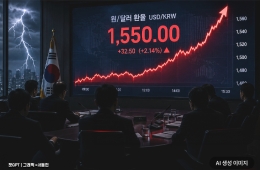
[US-Iran War] "Hedge Funds Bet on U.S. Stock Market Decline"
Stock Market Expected to Fall Due to Middle East War
Market Remains Stable... Fears Intensify
It has been revealed that U.S. hedge funds have significantly increased their short positions, betting on a decline in the U.S. stock market. This move comes as they anticipate further drops in stock prices due to the Middle East war that began last week with U.S. and Israeli airstrikes on Iran. While the U.S. stock market has remained relatively stable, underlying fears in the market appear to have intensified.
![[US-Iran War] "Hedge Funds Bet on U.S. Stock Market Decline"](http://www.asiae.co.kr/news/img_view.htm?img=2025040815114011311_1744092701.png)
According to Bloomberg News on March 8 (local time), citing a report from Goldman Sachs Group, hedge funds increased their short positions on U.S. equity exchange-traded funds (ETFs) by 8.3 percent during the previous week (March 2–6). This represents the largest increase since the "Tariff Liberation Day" in April, and it is also the second-largest increase in the past five years. Hedge funds have particularly concentrated their short positions on ETFs related to corporate bonds, energy, small-cap stocks, and large-cap stocks.
Market participants are also becoming more anxious. The VIX index (CBOE Volatility Index), Wall Street’s key volatility indicator, surged to its highest level since last year’s tariff shock. On March 6, Goldman Sachs’s so-called "US Vol Panic Index" also soared to 9.72 out of a maximum of 10 points.
However, the S&P 500 index fell only 2.02 percent based on closing prices from February 27 to March 6. Goldman Sachs described this minor decline, despite market concerns, as a kind of "false stability." Historically, geopolitical risks have typically triggered a roughly 4 percent drop in the index, so Goldman Sachs considers the recent market to be "relatively stable."
This also suggests that hedge funds have not completely turned to net selling. In fact, during the same period, their holdings of individual stocks rebounded for the first time in five weeks. Lee Koppersmith, Managing Director at Goldman Sachs, noted in a message to clients, "This confirms that investors are engaging in more hedging, but they are not meaningfully retreating from the market."
For the time being, volatility in the U.S. stock market is likely to increase. The international crude oil price surpassed $100 per barrel after Mojtaba Khamenei, the son of the late Ayatollah Ali Khamenei, was chosen as the next Supreme Leader. As of 6:20 p.m. on March 9, U.S. West Texas Intermediate (WTI) crude futures on the New York Mercantile Exchange (NYMEX) soared more than 20 percent at the start of trading, reaching $111 per barrel before settling around $100. Brent crude also surged over 17 percent to $111, then pulled back to the $100 level.
The three major New York stock indexes are likely to open lower during the regular session on March 9. According to U.S. business media outlet CNBC, stock futures, which serve as a leading indicator for the market, were all in decline on this day. Futures linked to the Dow Jones Industrial Average and S&P 500 were down about 2 percent, and Nasdaq 100 futures also fell 1.6 percent. CNBC reported, "Amid escalating tensions between the U.S. and Iran, U.S. crude oil prices have surpassed $100 per barrel, causing stock futures to plunge early in the week," and added, "There are growing concerns that rising energy prices could sharply slow the U.S. economy."
Hot Picks Today
 Ballot Box Found in Trash... Peru Holds Runoff Amid 'Ballot Shortage Crisis'
- "Brothers, You've Been Waiting for News?"... Orphanage Library Built Thanks to 'Money Brag' by SK hynix Employee
- [Breaking] Trump: "Israel and Iran Must Immediately Cease 'Firing'"
- Social Service Worker Indicted and Detained for Spraying Capsaicin on Toilet Paper and Illegally Filming in Women’s Restroom
- "Click! Gotta Post on SNS"... 'Small Luxury' for 20s and 30s Cools Down Amid High Inflation
Rick Rieder, Chief Investment Officer (CIO) of BlackRock, stated in a letter to clients on March 6, "The impact and duration of the Middle East war are highly uncertain, and the market is clearly unstable as this can lead to a wide range of outcomes for the economy and key market variables." He added, "Extreme fluctuations are appearing throughout the market as participants seek to reduce their excessively large positions or hedge their risks."
© The Asia Business Daily(www.asiae.co.kr). All rights reserved.



![[Breaking] President Lee Criticizes Election Commission: "No Excuse, Extremely Serious"](https://cwcontent.asiae.co.kr/asiaresize/307/2026060817232560108A.jpg)