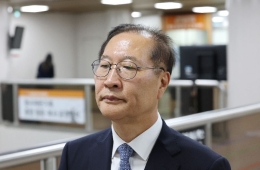
14 Former Bar Association and Women Lawyers Association Presidents Urge President Lee to Veto the Three Judicial Reform Bills
Passage of the Three Judicial Reform Bills in the National Assembly Plenary Session

Former presidents of the Korean Bar Association and the Korean Women Lawyers Association have defined the so-called "Three Judicial Reform Bills," which recently passed the National Assembly's plenary session under the leadership of the Democratic Party of Korea, as "judicial destruction that undermines the rule of law," and called on the President to exercise his veto power.
Eight former presidents of the Korean Bar Association (Park Seungseo, Ham Jungho, Jung Jaeheon, Chun Kihong, Shin Youngmoo, Ha Changwoo, Kim Hyun, Lee Jongyeop) and six former presidents of the Korean Women Lawyers Association (Kim Jungseon, Park Boyoung, Lee Myungsook, Lee Eunkyung, Cho Hyunwook, Wang Miyang) issued a joint statement on March 4, criticizing the legislation—which centers on the introduction of retrial petitions, the expansion of the number of Supreme Court justices, and the establishment of the crime of "judicial distortion"—as "a significant attempt to alter the structure of power, shaking the very foundation of South Korea's constitutional order."
They stated, "We define this situation, which was pushed through without sufficient social consensus or constitutional review, as a clear case of legislative overreach," and "we strongly urge the President to immediately exercise the right to request reconsideration (veto power)."
Regarding the introduction of the retrial petition system, they argued, "Allowing the Constitutional Court to overturn final Supreme Court rulings is not a matter of amending laws, but one that requires constitutional revision," and claimed, "By circumventing the constitutional system, the de facto introduction of a 'four-tier trial system' is clearly unconstitutional."
They further expressed concern, stating, "While retrial petitions would provide those in power with an opportunity to overturn Supreme Court decisions, ordinary citizens would become victims of litigation delays and soaring costs," and warned, "Ultimately, it would be reduced to a tool for the powerful to prolong proceedings."
Regarding the establishment of the crime of "judicial distortion," they pointed out, "The criteria for what constitutes 'distortion' are ambiguous, violating the principle of clarity in criminal law," and cautioned, "This could be abused as a means to politically indict and retaliate, undermining the independence of judges and prosecutors."
On the plan to increase the number of Supreme Court justices, they emphasized, "Expanding the number of Supreme Court justices to 26, with 22 of them appointed by President Lee Jaemyung, can only be seen as an attempt to dominate the judiciary."
Hot Picks Today
 "Why Is the Amount in My Account So Low?"... Why Pension Savings Subscribers Were Surprised
- As Kim Jong Un Death Rumors Spread... "It's Not Loading Again": North Korean State Media Sites Face Outages
- [Breaking] Shark 'Bukangi' exits channel... operation to guide it ends
- "After Sleeping Well with Strangers"... Who Is the 24-Year-Old Woman Who Won 19 Million Won?
- "I wanted her to feel my passionate love"... Wife collapses after husband's overly tight hug, diagnosed with broken ribs
They added, "This legislation undermines the balance of the separation of powers and is an attempt to restructure the power landscape, amounting to a regression. The President must fulfill his duty to uphold the Constitution by immediately exercising the veto against this unconstitutional bill."
© The Asia Business Daily. All rights reserved. Unauthorized AI training and use prohibited.





![[Editorial] Semiconductor Labor Exceptions: Don't Hide Behind Social Dialogue](https://cwcontent.asiae.co.kr/asiaresize/307/2026091511203728817_1789438836.jpg)
![[Editorial] Reviving the Special Inspector Is Only the Beginning... Authority and Scope Must Be Expanded](https://cwcontent.asiae.co.kr/asiaresize/307/2026091810333133998_1789695212.jpg)