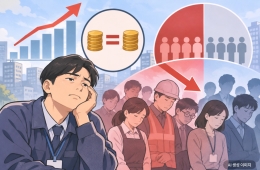
Savings Banks Facing a "Credit Cliff"... Will Mid-Rate Loan Rules Be Eased?
Regulatory fallout weakens momentum for higher deposit rates
The dilemma: tighter lending curbs versus shrinking inclusive finance
Meeting set for the 23rd... Will there be a signal of easing?
Although savings banks have restored deposit interest rates to the 3% range, they remain cautious about engaging in deposit-gathering competition through high-interest special offers as they did in the past. With their capacity to expand lending reduced due to government loan regulations, the industry is closely watching for possible regulatory easing, including measures to invigorate mid-rate loans.

According to the Korea Federation of Savings Banks on the 20th, the average interest rate on 12‑month time deposits at 79 domestic savings banks stood at an annual 3.02% as of the previous day. This is 0.07 percentage point lower than the 3.09% recorded a year earlier.
Deposit interest rates had remained in the high‑2% range until recently, but recovered to the 3% range as savings banks moved to defend their deposit base. However, the kind of "high‑interest special offer" competition seen in the past has not reappeared. Typically, savings banks have attracted funds at year‑end and the beginning of the year, when many deposit and installment savings products mature, by offering high‑interest products. Recently, however, such moves have visibly diminished.
The balance of deposits at savings banks also stood at only 99 trillion won as of the end of last year, falling below 100 trillion won. After the deposit insurance limit was raised in September last year from 50 million won to 100 million won, there had been expectations of deposit growth, but the balance instead declined for three consecutive months.
Impact of lending regulations slows mid-rate loans... Attention on the meeting on the 23rd
Industry insiders say that, since the June 27, 2025 household loan regulations limited credit loan ceilings to within one times annual income, the resulting reduction in lending capacity has left savings banks with insufficient incentive to aggressively raise deposit rates and expand their deposit base. An industry official said, "The reason some savings banks are currently maintaining interest rates at levels similar to commercial banks is largely due to the impact of lending regulations," adding, "In a situation where they cannot extend enough loans, they cannot keep increasing deposits, so deposit rates have remained at relatively low levels." The official also noted, "If regulatory easing creates more room for lending, there is a possibility that they will once again move actively to attract funds."
Against this backdrop, the savings bank industry is hoping that a signal of easing credit loan regulations will emerge at the meeting scheduled for the 23rd between Financial Services Commission Chairman Lee Eokwon and savings bank chief executive officers (CEOs). In particular, they are expected to propose regulatory easing aimed at invigorating mid-rate loans for mid- to low‑credit borrowers. Mid-rate loans, which carry higher interest rates than bank credit loans but are less burdensome than card loans or private lending, are products targeted at individuals in the bottom 50% of the personal credit score distribution. As of the second half of last year, the amount of private‑sector mid-rate loans supplied by savings banks was 3.3785 trillion won, down by about 38% compared with the first half (5.4891 trillion won).
Hot Picks Today
 "Two Spend 500,000 Won in a Flash, Yet Wait Two Hours?" ... 'Dreamland' Shunned by Kids and Foreign Tourists
- The Era of Getting 200 Million Won After 30 Years Is Over... A Japanese Bank's "Perpetual Department Head" Who Just Clocked In Cries Out
- Spain Hit by Its Worst Tragedy... Lee Kangin, Moreno and Real Madrid Join Soccer World in Mourning
- They Said, “Make It Your Home for Life” - Then Suddenly Kicked 200 Passengers Off... What Happened to the Around-the-World Cruise?
- "130 Rice Bowls Sold Out in a Day"... 'Unfiltered Face' Adds 8 Million Won to Night Market Sales: China's Bungeunwoo
Earlier, at a National Assembly Political Affairs Committee work report on the 5th, Chairman Lee said with regard to household debt, "Last year, the growth rate of household loans in the banking sector was 1.8%, which was very low, but this year we are trying to keep it even lower." He added, however, "Truly low‑income people may suffer relative losses or damage, so for products mainly used by ordinary people, such as Saehuimangholssi loans and mid-rate loan products, we are considering separating them out when managing overall volumes and thinking carefully about how to design and manage them well." In addition, Financial Supervisory Service Governor Lee Chanjin stated in his New Year’s address last month that he would promote expansion of inclusive finance for vulnerable groups and the revitalization of mid-rate loans.
© The Asia Business Daily. All rights reserved. Unauthorized AI training and use prohibited.