"Warsh Shock" Sends Exchange Rate Soaring by 25 Won... Highest in Six Trading Days (Update)
USD-KRW Closes at 1,464.3 on February 2
Hawkish Stance of Next Fed Chair in Focus
Strong Dollar and Foreign Investor Sell-Off Drive Market
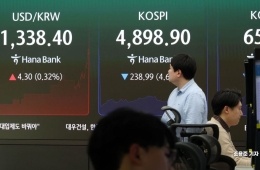
The USD-KRW exchange rate surged by nearly 25 won in a single day, closing higher at the 1,460 won level. The so-called "Warsh Shock" rattled both the dollar's trajectory and the stock market.

On the 2nd, the USD-KRW exchange rate is displayed on the status board in the Shinhan Bank dealing room in Jung-gu, Seoul. Provided by Shinhan Bank
View original imageOn February 2, in the Seoul foreign exchange market, the weekly closing price (as of 3:30 p.m.) for the USD-KRW exchange rate was 1,464.3 won, up 24.8 won from the previous trading day. This marks the first time in six trading days that the rate has surpassed 1,460 won, the last occurrence being on January 23 (1,465.8 won).
The exchange rate opened at 1,451.0 won, up 11.5 won from the previous day, fluctuated in the mid-to-high 1,450 won range, and then expanded its gains in the afternoon to ultimately close above 1,460 won. In terms of weekly closing prices, this is the highest since January 23.
At the beginning of the year, the USD-KRW exchange rate was close to 1,480 won, but it fell to 1,422.5 won on January 28, following indications of an unusual joint intervention by US and Japanese foreign exchange authorities and remarks by US President Donald Trump suggesting tolerance for a weaker dollar.
However, the trend reversed over the weekend (January 30, local time) when President Trump nominated Kevin Warsh as the next Fed Chair to succeed the current chair whose term expires in May. In particular, Warsh's past reputation as a "hawk" during his tenure as a Fed Governor drew attention, dampening expectations for a US base rate cut and boosting the dollar's strength. The dollar was further buoyed by the US Producer Price Index (PPI) for December last year, which rose 0.5% from the previous month, exceeding market expectations.
The dollar index (DXY), which measures the value of the dollar against the currencies of six major countries, continued at around 97.16, up about 0.05% from the previous day. After falling to the 95 range during trading on January 27, it has since rebounded.
In contrast, the market responded to Warsh's nomination with concerns that his monetary policy stance would be unfavorable for financial markets, leading to sharp declines in gold, silver, the New York stock market, and Bitcoin prices. In the domestic KOSPI market, foreign investors net sold as much as 2.515 trillion won, further weakening the won. Only individual investors stepped in, net buying 4.4861 trillion won and absorbing the "panic selling" volume.
The won's depreciation was even steeper than that of the yen on this day. The KRW-JPY cross rate stood at 945.78 won per 100 yen, up 10.34 won from the previous day's reference price of 935.44 won at the same time. The JPY-USD exchange rate was recorded at 154.640 yen, down 0.12 yen.
Hot Picks Today
 "Two Spend 500,000 Won in a Flash, Yet Wait Two Hours?" ... 'Dreamland' Shunned by Kids and Foreign Tourists
- The Era of Getting 200 Million Won After 30 Years Is Over... A Japanese Bank's "Perpetual Department Head" Who Just Clocked In Cries Out
- Spain Hit by Its Worst Tragedy... Lee Kangin, Moreno and Real Madrid Join Soccer World in Mourning
- They Said, “Make It Your Home for Life” - Then Suddenly Kicked 200 Passengers Off... What Happened to the Around-the-World Cruise?
- "130 Rice Bowls Sold Out in a Day"... 'Unfiltered Face' Adds 8 Million Won to Night Market Sales: China's Bungeunwoo
Park Sanghyun, a researcher at iM Securities, said, "The foreign exchange market's attention will remain focused on the policy stance of the next Fed Chair for the time being, so high volatility is expected." He added, "However, given that President Trump made a half-joking, half-serious remark that he would sue if Warsh does not cut rates, the likelihood of sustained dollar strength due to Warsh's nomination appears low."
© The Asia Business Daily. All rights reserved. Unauthorized AI training and use prohibited.