"Secondary Damages from Personal Data Leaks": 1.2 Billion Won in Fines for National Research Foundation of Korea and Others
Personal Information Protection Commission Holds 2nd Plenary Meeting
National Research Foundation of Korea: Data Leak of 120,000 People
700 Million Won Fine... Disciplinary Action Recommended for Those Responsible
Tmoney Fined 530 Million Won for Leaking Data of 50,000 Users
NHN Commerce Advised to Provide New Solution
The Personal Information Protection Commission announced on January 29 that it has imposed a total of approximately 1.2 billion won in fines on the National Research Foundation of Korea, Tmoney, and others, where personal information leaks led to secondary damages.

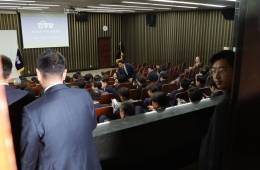
Song Kyunghee, Chairperson of the Personal Information Protection Commission, is striking the gavel at the 2nd plenary session of 2026 held at the Government Seoul Office on the afternoon of the 28th. Photo by Personal Information Protection Commission
View original imageAt the 2nd plenary session held the previous day, the Commission decided to impose a total of 707.8 million won in fines and penalties on the National Research Foundation of Korea, which leaked the personal information of 120,000 people.
The hacking incident occurred in June of last year on the foundation's online paper submission system (JAMS). According to the Commission's investigation, the hacker exploited a vulnerability in the "Find Password" URL on the academic society pages within JAMS, manipulating parameters and randomly inputting email addresses to access the personal information of about 120,000 JAMS members. The exposed information included 44 items such as names, IDs, emails, mobile phone numbers, and bank account numbers. In addition, 116 resident registration numbers were leaked, and there were even cases of secondary damage involving identity theft using JAMS member information.
The Commission pointed out that the foundation failed to detect and address a vulnerability that had existed since 2013. The foundation only checked for vulnerabilities on the JAMS portal, neglecting the approximately 1,600 academic society pages. Furthermore, at the time of notification of the leak, highly identifiable information such as bank account numbers and researcher registration numbers were omitted, and after the hacking incident, sufficient system improvements were not made.
Considering this a very serious data breach, the Commission imposed a fine of 703 million won and a penalty of 4.8 million won on the foundation. The Commission ordered a re-notification of the data breach, including the previously omitted items, and a vulnerability check of JAMS, and recommended the establishment of a personal information protection system and disciplinary action for those responsible, appropriate for a national core research institution. The results of these measures will be published on the Commission's website for one year.
Based on the results of an investigation into a personal information leak report received in April last year, the Commission also imposed a fine of 534 million won on Tmoney, citing neglect of its obligation to take safety measures under the Personal Information Protection Act.
Between March 13 and 25 last year, an unidentified hacker used a "credential stuffing" attack to break into the Tmoney Card and Pay websites, stealing the personal information of 51,691 people. Credential stuffing is a hacking method that attempts to log in to a site using previously obtained account and password information until successful. The investigation found that the hacker used 9,647 domestic and international IP addresses to attempt up to 131 logins per second, up to 5,265 logins per minute, and more than 12.26 million total login attempts on the website. After successfully logging in, the hacker accessed 4,131 accounts and stole approximately 14 million won in remaining "T-Mileage" points using the gift function, causing secondary damages.
The Commission stated that Tmoney neglected its obligation to take safety measures against abnormal signs, resulting in the data breach. In addition to the fine, the Commission ordered the company to publicly disclose the facts on its website and to establish measures to prevent recurrence. The Commission stated, "As credential stuffing attacks are occurring frequently, we urge companies to strengthen security measures against abnormal access and suspicious activity. Measures such as de-identifying personal information on exposure pages and applying additional authentication when accessing pages containing personal information can help prevent such incidents."

Additionally, the Commission decided to impose a fine of 8.7 million won, a penalty of 4.5 million won, and a public disclosure order on NHN Commerce. This was due to a total of 122 cases of personal information leaks involving orderers on the "eNamu" solution, a software-as-a-service (SaaS) platform provided to business users wishing to build online stores. The solution, which has been in service for over a decade, suffered from insufficient technical support and security management, and the attack was carried out in the form of an SQL injection on the shopping cart-related web page. This hacking technique involves manipulating database (DB) queries (SQL queries) abnormally to gain unauthorized access to information.
At the time of the attack, NHN Commerce immediately identified the scope and content of the leaked personal information and completed the report within 72 hours. However, the Commission pointed out that notification to business users was limited to a one-time email or phone call, without confirming whether the notification was actually received, and thus notification to data subjects was ultimately incomplete.
Hot Picks Today
 "Two Spend 500,000 Won in a Flash, Yet Wait Two Hours?" ... 'Dreamland' Shunned by Kids and Foreign Tourists
- The Era of Getting 200 Million Won After 30 Years Is Over... A Japanese Bank's "Perpetual Department Head" Who Just Clocked In Cries Out
- Spain Hit by Its Worst Tragedy... Lee Kangin, Moreno and Real Madrid Join Soccer World in Mourning
- They Said, “Make It Your Home for Life” - Then Suddenly Kicked 200 Passengers Off... What Happened to the Around-the-World Cruise?
- "130 Rice Bowls Sold Out in a Day"... 'Unfiltered Face' Adds 8 Million Won to Night Market Sales: China's Bungeunwoo
In addition to administrative measures, the Commission recommended supporting the migration to an alternative solution, considering the low usage rate of "eNamu," the dissolution of its dedicated team, and its history of similar hacking incidents. The Commission emphasized, "Only when large-scale service providers implement personal information protection measures appropriate to their role can the security level of many business users, including small business owners, be achieved."
© The Asia Business Daily. All rights reserved. Unauthorized AI training and use prohibited.