Gwangju Democratic Party Branch Sets Up Memorial Altar for Former Prime Minister Lee Hae-chan
Operated for Five Days at May 18 Democracy Square
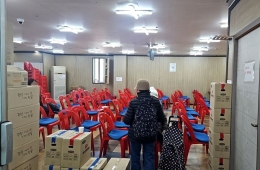
The Gwangju Metropolitan City branch of the Democratic Party of Korea will set up a joint memorial altar at the May 18 Democracy Square to honor the late former Prime Minister Lee Hae-chan, and will operate it for five days starting from the 27th.

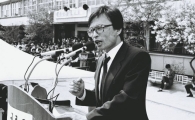
The National Unification Advisory Council announced that Lee Hae-chan, Senior Vice Chairman of the Democratic Peaceful Unification Advisory Council, passed away on the 25th while undergoing treatment in Vietnam. He was 73 years old. The photo shows Lee Hae-chan, then Prime Minister, delivering his inaugural speech at the inauguration ceremony held at the government office on June 30, 2004. Photo by Yonhap News Agency
View original imageOn the 26th, the Gwangju branch announced, "To mourn his passing and honor his dedication to the advancement of democracy, a joint memorial altar will be established at the May 18 Democracy Square (Geumnam-ro 1-ga, Dong-gu)." The altar will be open from 9 a.m. to 9 p.m. for five days, from the 27th to the 31st, providing a space where citizens can voluntarily offer flowers and incense.
The Gwangju branch plans to ensure that citizens can pay their respects in a solemn manner during the altar's operation, by providing guidance and maintaining order. The party-level joint memorial service will be held at 11 a.m. on the 27th, with public officials and key party members in attendance.
In a memorial statement released that day, the Gwangju branch said, "Former Prime Minister Lee Hae-chan was a politician of action who defended democracy during the era of dictatorship and authoritarianism, and a figure who lived through the tumultuous half-century of Korean democracy." They also noted that in his youth, he was imprisoned for his participation in the democratization movement against the Yushin regime, and that he played a leading role in the historic transition to a direct presidential election system following the June Struggle of 1987.
The branch further evaluated that, as a seven-term lawmaker, Prime Minister, and party leader, he fulfilled his responsibilities for the unity of the democratic camp and the administration of state affairs, serving through the Kim Dae-jung, Roh Moo-hyun, and Moon Jae-in administrations, and up to the launch of the Lee Jae-myung administration.
The Gwangju branch especially emphasized that former Prime Minister Lee Hae-chan took the lead in uncovering the truth of state violence through his work on the National Assembly's Special Committee for the Investigation of the May 18 Gwangju Democratization Movement. He consistently asserted that Gwangju should not merely be a subject of remembrance, but a history of democracy for which the state must take responsibility, advocating for politics based on truth and accountability.
The Gwangju branch stated, "The late Lee Hae-chan's commitment to democracy and responsible politics aligns with the values that Gwangju has upheld," adding, "We will carry on his spirit with responsibility in our region and on the ground."
© The Asia Business Daily. All rights reserved. Unauthorized AI training and use prohibited.