[Reporter’s Notebook] K-Bio in the Global Spotlight: Now It's Time to Prove It

"This is a Korean event, right? There are so many people here that you won't be able to get in anyway."
On the 14th (local time), during the JP Morgan Healthcare Conference (JPMHC), such remarks could be heard several times among people passing by the entrance to the 'Korea Night' event held at The Howard Hotel in San Francisco, USA. Korea Night is a global networking event hosted by the Korea Biotechnology Industry Organization (KoreaBIO).
This year's event drew a large crowd of representatives from major biotech and global pharmaceutical and investment firms from North America, Europe, and Asia. Although the venue could accommodate about 650 people for a standing reception, more than 1,500 people had registered in advance to attend. Korea Night has now fully transformed from being simply a 'gathering place for Koreans abroad' to 'a destination where the global community comes to Korea'.
This atmosphere was not unique to Korea Night. Throughout JPMHC, the perception of Korean companies shifted from simply acknowledging their presence with comments like "Did such companies exist in Korea?" to the stage of verifying their concrete competitiveness, including clinical trials and commercialization. Inquiries now focused on questions such as, "What clinical data do you have?", "What is the target indication?", and "How reproducible and scalable is the platform technology?"
Seulgi Lee, CEO of D&D Pharmatech, who was interviewed on-site at JPMHC, commented, "I felt as if Korean biotech was receiving special attention," adding, "Perhaps due to the recent stock market environment, even global institutional investors who previously had no interest in Korean biotech are now showing interest. This is a particularly notable change."
However, this change in status does not immediately translate into new drug competitiveness. Sang Hoon Lee, CEO of ABL Bio, whom we met at JPMHC, observed that "Previously, Western big pharma companies were actively looking to China, but now there is a growing perception that 'Korea is next after China'." Nevertheless, he also pointed out that the barriers of 'capital' and 'clinical sophistication' that Korea must overcome remain high.

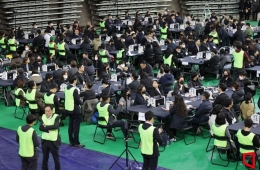
At the 'Korea Night' event held at The Howard Hotel in San Francisco on the 14th (local time) during the JP Morgan Healthcare Conference (JPMHC), the venue was packed with attendees. Korea Biotechnology Industry Organization (KoreaBIO)
View original imageSince Korean biotechs still lack the large-scale, late-stage clinical data—trials involving hundreds of participants—preferred by big pharma, Korea continues to be primarily evaluated for its 'early-stage technology.' In technology transfer agreements, candidates in preclinical or phase 1 clinical stages are not highly valued.
CEO Lee stated, "The ideal model is to generate revenue through technology transfer and then use those funds to push clinical trials further toward commercialization. Korean companies need to move from 'early-stage technology' to 'clinical and commercial stages' in order to strengthen their negotiating power with big pharma."
Hot Picks Today
 "Two Spend 500,000 Won in a Flash, Yet Wait Two Hours?" ... 'Dreamland' Shunned by Kids and Foreign Tourists
- The Era of Getting 200 Million Won After 30 Years Is Over... A Japanese Bank's "Perpetual Department Head" Who Just Clocked In Cries Out
- Spain Hit by Its Worst Tragedy... Lee Kangin, Moreno and Real Madrid Join Soccer World in Mourning
- They Said, “Make It Your Home for Life” - Then Suddenly Kicked 200 Passengers Off... What Happened to the Around-the-World Cruise?
- "130 Rice Bowls Sold Out in a Day"... 'Unfiltered Face' Adds 8 Million Won to Night Market Sales: China's Bungeunwoo
Korea's pharmaceutical and biotech industry has built its fundamentals and capabilities through CDMO (Contract Development and Manufacturing Organization) and biosimilar businesses, represented by companies such as Samsung Biologics and Celltrion. Based on the regulatory experience and capital accumulated over time, they must now endure new drug risks and prove themselves through clinical trials. The long line in front of Korea Night was just another starting signal for K-bio. The real competition begins now.
© The Asia Business Daily. All rights reserved. Unauthorized AI training and use prohibited.