[2026 K-Film] The '10 Million Viewer Fantasy' Is Over... Survival Depends on Slimming Down and Buying Time
'Zero Investment, Soaring Costs': A Double Whammy
52-Hour Workweek and Standard Contracts Entrench High Costs
Without Selling 'Experiences,' Theaters Become Warehouses

The number of moviegoers who visited theaters last year was only 106.08 million. Photo by Yonhap News
View original imageSpring has not yet arrived in Chungmuro. Three years after the end of the pandemic, the annual number of moviegoers remains trapped in the 100 million range. Audiences, now accustomed to online video services (OTT) and short-form content, are making cold decisions based on "time-to-value" and turning away from theaters. For the Korean film industry, which is facing a freeze in investment, brutal self-assessment and restructuring-in other words, a "diet"-are inevitable for survival.
A Broken Middle... Shifting to 'Small but Strong' Films
The essence of the crisis lies in "high costs and low efficiency." The strategy of betting on tentpole films with production budgets exceeding 20 billion won for a windfall has resulted in dismal success rates. According to the Korean Film Council, the break-even rate for commercial films last year dropped to the low 20% range. In other words, eight out of ten films failed. Once the illusion of "10 million-viewer films" faded, the stark reality of the market was laid bare.
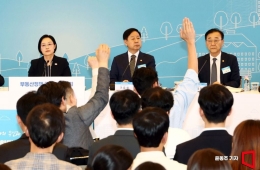
The solution lies in restoring the "middle" that has collapsed. Lee Hayoung, Executive Committee Member of the Korean Film Producers Association, stated, "To maintain the ecosystem, at least fifty films need to be lined up annually," and added, "We must compete with 'smart planning,' such as genre films targeting people in their teens and twenties, within limited capital."

The government is also rolling up its sleeves. Kim Jihee, Director of the Visual Broadcasting Content Industry Division at the Ministry of Culture, Sports and Tourism, said, "Injecting public funds is inevitable to prevent market failure of mid-budget films," and announced, "Starting this year, we will directly support a total of 20 billion won for approximately 18 'small but strong' films with net production costs between 2 billion and 10 billion won."
Rising Cost Floor... AI Becomes a Survival Requirement
The main obstacle to "slimming down" is the rigid cost structure. With the implementation of the 52-hour workweek, the previous method of relying on staff's "hunger spirit" to reduce costs no longer works. This is why artificial intelligence (AI) is attracting attention as the key to breaking the structure in which costs increase exponentially as filming time lengthens.
In particular, by using generative AI to simulate movement during pre-production, it is possible to reduce wasted time on set to nearly zero. Song Jaewon, Head of Research and Development at Dexter Studio, explained, "The key is to leave simple, repetitive tasks to AI and allow creators to focus on improving quality."

This also presents an opportunity for Korean cinema to narrow the gap with Hollywood. Cho Youngshin, Visiting Professor at Dongguk University Media Research Institute, commented, "Unlike Hollywood, where union issues slow things down, Korea can adopt these changes more flexibly," and assessed, "With AI as a new starting line, we can pursue a 'first mover' strategy."
Tasks Ahead of Regulation... Theaters Sell 'Experiences'
Even if production costs are reduced, it is meaningless if theatrical distribution collapses. While discussions about "holdback" regulations to prevent OTT departures are heating up, the core issue is providing an "irreplaceable experience."
It is urgent to combine special formats (such as IMAX), which cannot be replicated on smartphones, with fandom business models. Hwang Jaehyun, Head of Strategy Support at CGV, said, "Theaters must reinvent themselves as 'plazas of empathy' by connecting audiovisual pleasure with fandom culture, such as merchandise."
Hot Picks Today
 Is the Stock Market Decline Just Beginning? "An Even Bigger Crisis Is Coming," Warns Rich Dad Author
- [Exclusive] SK hynix to Build Headquarters in Central Seoul... Plans New Office on Former Le Meridien Gangnam Site
- "With My Young Daughter Present": Active Police Officer Goes Shirtless and Verbally Abuses Parent... Police "Fact-Finding Underway"
- It Was a Sensation in Korea Too..."Can't Live Without It" - Japanese Elementary Students Also Obsessed With This
- "Prettier Than Idols?" "Tight Outfits Stir Debate"... Why the Virtual Female Weathercaster Is Causing a Stir

The year 2026 is the final golden time to determine the industry's sustainability. Leaner planning, AI-based process innovation, and overwhelming theater experiences-unless these three factors come together, the blackout on the screen may not end for some time.
© The Asia Business Daily. All rights reserved. Unauthorized AI training and use prohibited.