BJFEZ Identifies Regulatory and Institutional Improvement Tasks Through Strategic Item Consulting
Coffee, Ship Components, and Clean Fuels
On-Site Challenges Compiled into Policy Tasks
The Busanjin-Hae Economic Free Zone Authority (headed by Park Seongho) has identified regulatory and institutional improvement tasks related to strategic items such as coffee, ship components, and clean fuels (hydrogen and ammonia) through the 'BJFEZ Strategic Item New Business Consulting Support Project.'
This project was established to support new business initiatives of companies within and near the BJFEZ, focusing on its five strategic items: coffee beans, cold chain components, hydrogen energy, ship machinery components, and robot parts. The aim is to systematically address and turn on-site challenges into policy tasks.
The Authority selected six participating companies related to the strategic items through an open call. Subsequently, each company conducted one-on-one consulting sessions with experts of their choice, collaboratively designing market and demand analyses, business model development, and step-by-step implementation plans.
A key achievement of this process is the separate identification and grouping of regulatory and institutional issues that companies repeatedly raised, which have now been compiled as improvement tasks.
In the coffee sector, there were concerns about the ambiguous interpretation of caffeine content labeling standards, as well as the overly complex residency, taxation, and customs standards applied to coffee manufacturing, processing, and contract processing in Free Trade Zones and Economic Free Zones. The Authority has organized these as tasks to 'revise caffeine content labeling and certification standards' and 'improve coffee manufacturing and processing systems within Free Trade Zones.'
In the ship components and logistics sector, opinions were expressed that when establishing a smart logistics center capable of specialized storage and management of ship machinery and components in port hinterland areas, relevant certification standards and residency/support systems should be designed in tandem.
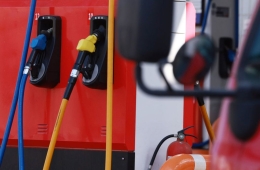
Additionally, in the clean fuel sector, including ammonia, it was commonly identified that there is a need to proactively establish safety standards and certification systems for ship fuels, burners, and boilers, thereby laying the groundwork to connect future International Maritime Organization (IMO) standards with domestic demonstration and commercialization.
The Authority plans to further develop these tasks by submitting them as agenda items to in-zone consultative bodies such as the 'Coffee Industry Vitalization Task Force,' 'Global Logistics Innovation Task Force,' and the 'Smart Transport Equipment Planning Committee.' The intention is to link the outcomes of these discussions to future government projects and policy proposals, thereby enhancing their implementation.
Hot Picks Today
!["Scored Gains Again With Short-Term Trades"?But Is It Worth Celebrating? Endless Copycat ETFs in a Crowded Market [The 400 Trillion Won ETF Era]](https://cwcontent.asiae.co.kr/asiaresize/93/2026033110173797170_1774919857.png) "Scored Gains Again With Short-Term Trades"?But...
"Scored Gains Again With Short-Term Trades"?But...
- "Japanese Consumers Fall for K-Beauty Like Korean Women... Qoo10 Japan Achieves ...
- "Life Is Sweet After Skipping Studies and Getting a Job"... SK Hynix Production ...
- Samchundang Pharm Chairman Rises to Korea’s Top 10 Wealthiest... Surpassing Par...
- Israeli Soldier Smiling, Woman Trembling... Italian Magazine Photo Shocks the Wo...
Director Park Seongho stated, "This consulting project is meaningful in that it systematically collected on-site regulatory and institutional challenges, going beyond mere business planning," adding, "We will strengthen follow-up support so that the voices of companies can lead to actual institutional improvements and national projects by linking with task forces and committees."

© The Asia Business Daily(www.asiae.co.kr). All rights reserved.