Jeju Transforms from Tourist Destination to Space Industry Cluster...Aiming for 'Aerospace Opportunity Development Zone'
Full-Scale Launch of the “Jeju-Style Space Valley” Connecting Manufacturing, Launch, Control, and Data Utilization
With the establishment of the nation’s largest private satellite manufacturing hub by Hanwha Systems, the operation of commercial ground station services by CONTEC, and the transformation of Hallim Technical High School into the country’s first specialized high school for space studies, Jeju is setting a new course as the “forward base of Korea’s private space industry.”

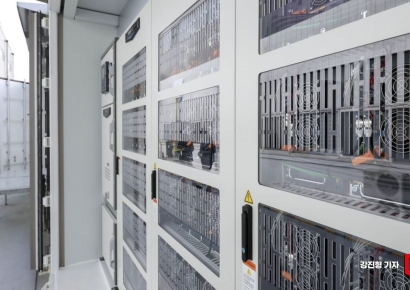
CONTEC Jeju Ground Station located in Sangdae-ri, Hallim-eup, Jeju City, Jeju Island. Multiple satellite antennas are operated, receiving observation data downloaded from low Earth orbit satellites and transmitting it in real time to domestic and international companies and institutions. Provided by CONTEC.
View original imageThe “Jeju-style Space Valley” initiative is now entering the implementation phase, where satellites manufactured on Jeju are launched from the waters off its coast, signals are received at the ground station for data processing and utilization, and the ecosystem expands into space experience tourism and industrial services.
Oh Younghoon, Governor of Jeju Special Self-Governing Province, stated at a press conference with the aerospace press corps on December 1, “Based on Jeju’s geographic advantages and the concentration of private space companies, we will incorporate the ‘private opportunity development zone’ model into the national space plan. We will create a site for the private space economy in Jeju, where satellites are manufactured, launched, and the data is utilized.”

Oh Younghoon, Governor of Jeju Special Self-Governing Province. Provided by Jeju Special Self-Governing Province.
View original imageJeju Proposes Expansion from ‘Three Major National Space Hubs’ to ‘3+1’ Model
The current national space strategy established by the government is built on three pillars: Daejeon (space research and talent development), Goheung in South Jeolla Province (launch vehicle base), and Jinju and Sacheon in South Gyeongsang Province (satellite development). Jeju is not yet included in this framework.
Jeju plans to propose expanding this structure to a “3+1 system” by adding a private-sector-focused downstream industry hub to the national space strategy. The vision is to integrate a private-led space business model into the national strategy, where satellites manufactured in Jeju are launched from its coastal waters and the collected satellite data is directly utilized and serviced on-site.

Jeju Province Proposes the '3+1' National Space Strategy Framework. Provided by Jeju Special Self-Governing Province.
View original imageAt the center of this strategy is the Hanwha Systems Jeju Space Center, which was completed on December 2. Built on the former Tamna University site with a total floor area of 10,000 square meters, this facility is the nation’s largest private satellite manufacturing and testing infrastructure, equipped for satellite development and assembly, thermal vacuum and near-field testing, and an integrated test clean room. Starting next year, it will be capable of mass-producing up to 100 small SAR (Synthetic Aperture Radar) satellites annually.
Jeju’s geographic conditions also serve as a competitive advantage for the space industry. Surrounded by sea on all sides, it is favorable for securing launch angles and designating drop zones, allowing completed satellites to be launched directly from the waters off Jeju without land transport. Jeju is drawing attention as the only region in Korea with geographic conditions that enable the full process from satellite manufacturing to maritime launch.

A bird's-eye view of Jeju Space Center, completed by Hanwha Systems on the 2nd in Haweon-dong, Seogwipo-si, Jeju. Provided by Hanwha Systems.
View original imageExpanding Jeju’s Space Ecosystem: From Control and Data Industries to Talent Development
The presence of CONTEC, a global satellite ground station service provider, is another key pillar of Jeju’s space industry structure. Jeju is known to receive identical satellite signals up to four seconds faster than other regions, enhancing communication and control efficiency. Hanwha Space Center (manufacturing), CONTEC (ground station and data), and Hallim Technical High School (talent development) form the three pillars of the private space industry value chain being established in Jeju.
Leveraging these geographic advantages, CONTEC plans to expand its ground station, control, and data processing centers in Jeju, serving as a global data hub in collaboration with major satellite operators worldwide. Lee Jaewon, Executive Vice President for Space Business at CONTEC, stated, “Jeju is the optimal location for private ground station services due to minimal radio interference and limited airspace restrictions. We will establish a satellite data operations node in Jeju to strengthen our global service capabilities.”
Hallim Technical High School is also a crucial link in the industrial ecosystem. Designated this year as the nation’s first “Specialized High School for Aerospace Cooperation,” it offers hands-on training in satellite assembly, control, and testing at the high school level. A curriculum jointly designed by the school, Jeju Province, and private companies is being implemented, and graduates have already been officially hired by Hanwha Systems.

Students of Hallim Technical High School, which was designated this year as the nation's first "Specialized High School for Aerospace Cooperation," are attending classes. Starting next year, the school's name will be changed to Hallim Aerospace High School. Provided by Hallim Technical High School.
View original imageLee Jinseung, Principal of Hallim Technical High School, said, “A talent ecosystem linking education, employment, and settlement is already in operation, demonstrating the potential for space professionals to take root in Jeju.” Jeju plans to further establish a regional talent development system for space professionals, extending to universities and graduate schools.
Starting in 2026, Jeju will promote a satellite information utilization cluster to deploy SAR data in key industries such as agriculture, environment, maritime, and transportation, and will also launch a next-generation premium tourism model that combines launch viewing and ground station tours with space experience tourism.
“Jeju Is Where the Private Space Economy Becomes a Real Market”
Of course, challenges remain. Issues such as maritime control standards, safety manuals, resident acceptance, legal framework improvements, and industry sustainability must be thoroughly reviewed.
Jeju is establishing a regulatory foundation by conducting technical verification through national research institutes and working to attract the Aerospace Administration and the ground system for the Korean Positioning System (KPS). The island, long known for tourism, is now charting a new course as a testbed for the private space economy and a bridgehead for future industries.
Hot Picks Today
 If You Order Now, Delivery Takes 4-5 Years... "...
- "If You Had Followed a Year Ago, You'd Be Rich Now"... How the National Pension ...
- "It's Easier to Just Heat It Up in the Microwave"... Once a Multi-Billion Market...
- Man in His 30s Urgently Arrested for Taking Intoxicated Woman from Street to His...
- "I Kept Quiet Not to Lose the Good Energy"... Wins Both 1st and 2nd Prizes After...
Kim Gihong, Director of the Space Mobility Division of Jeju Special Self-Governing Province, said, “Jeju is not simply bringing in the national space plan, but designing a site where the private satellite data industry generates real business results and jobs. The Hanwha Space Center, CONTEC, and Hallim Technical High School are just the starting point, and we will prove that Jeju can become the main stage for downstream industries.”
© The Asia Business Daily(www.asiae.co.kr). All rights reserved.