[Q&A] FSS Chief Lee Chanjin: "No Disagreement with FSC on Samsung Life's Accounting Deviation"...Hints at Restoration
First Press Conference 110 Days After Taking Office
Lotte Card: "Strict Sanctions Will Be Imposed"
"Organizational Restructuring by End of December, Executive Appointments by January 10"
Lee Chanjin, Governor of the Financial Supervisory Service, announced on December 1 that he will discontinue the exception to the application of International Financial Reporting Standard 17 (IFRS17) for Samsung Life Insurance, which was implemented during the previous governor's term, and will restore the original standard. He added that the Financial Services Commission has no objections to this decision. Regarding the Lotte Card incident, he emphasized that strict sanctions are necessary.
Regarding organizational restructuring and executive appointments, he stated, "The organizational restructuring will be completed by the end of this month, and executive appointments will be finalized by the 10th of next month."

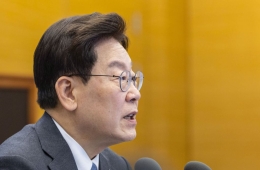
Lee Chanjin, Governor of the Financial Supervisory Service, is speaking at his first press conference held on the 1st at the Financial Supervisory Service headquarters in Yeouido, Seoul. Financial Supervisory Service
View original imageGovernor Lee provided these explanations regarding organizational restructuring and executive appointments at his first press conference held at the headquarters in Yeouido, Seoul, on this day.
The following is a Q&A with Governor Lee.
-You mentioned plans to restore the original accounting standards regarding Samsung Life Insurance's deviation from standard accounting. Will this be reflected in this year's financial statements or from the first quarter of next year?
▲To avoid confusion, it was decided not to retroactively apply the change for this year. Therefore, this year's financial statements will not reflect the adjustment.
-Three years ago, the Financial Supervisory Service allowed the deviation based on its interpretation. Is the restoration now due to a reassessment of the previous decision, or has the situation changed?
▲At the time, there was a perceived need to allow the exception, but now that necessity no longer exists. We are returning to the standard adopted and ratified by the Financial Supervisory Service in accordance with IFRS17.
-Will the conclusion regarding Samsung Life Insurance's deviation be finalized at today's meeting? Are there any variables going forward?
▲As far as I know, there are no disagreements with the Financial Services Commission. The matter will be discussed this afternoon, and if necessary, there may be an additional meeting, but I have been informed that there are few differences of opinion. A conclusion will be reached as early as the end of this month or, at the latest, by next month. Any necessary revisions related to follow-up actions will be coordinated internally with the Financial Services Commission.
-Lotte Insurance has filed an administrative lawsuit against the prompt corrective action, claiming that the non-quantitative assessment is potentially illegal. What is your view?
▲I have received reports regarding Lotte Insurance's non-quantitative assessment related to the prompt corrective action, but no particular issues were found. From a soundness perspective, there are significant concerns. It appears that a private equity fund is the major shareholder, and there are uncomfortable aspects, which may have led to the lawsuit. I do not believe there will be major issues, but we will monitor the outcome of the lawsuit before making a final judgment.
-How is the supervision and inspection of the Lotte Card personal information leak incident progressing?
▲The investigation into Lotte Card is nearly complete. Based on the results, strict sanctions are likely to be imposed. Comparing the hacking incidents at Lotte Card and Coupang, investment in this area is generally inadequate compared to other countries. These costs must be properly reflected. There is a lack of consumer protection provisions related to system security in the current Financial Consumer Protection Act. We are working to comprehensively revise the relevant laws. At a minimum, regulations and sanctions equivalent to those under the Capital Markets Act will be introduced through legislative amendments.
-Are you monitoring risks related to the recent high exchange rate? As a former member of the National Pension Fund Management Committee, do you think the National Pension Service should hedge foreign exchange risks?
▲We need to pay attention to the soundness of some financial institutions' foreign exchange exposures, and we are continuously monitoring this. There are no figures indicating unusual problems, so there is not much cause for concern at this time. Whether to hedge foreign exchange risks is a decision for the National Pension Service. However, the National Pension Service has become a 'giant' in the market, including the foreign exchange market. The expansion of overseas investment is a subsequent issue. The fact that the National Pension Service has become a dominant player in the foreign exchange market raises social questions. If foreign exchange issues persist, asset polarization may worsen, and there needs to be a social discussion on how to address the National Pension Service's influence on this issue.
-There was a stock swap issue between Naver Financial and Dunamu. What is your stance on big tech companies entering the financial sector?
▲They are expected to submit a securities registration statement around February or March next year. Big tech companies are currently separated from financial institutions, but with the second stage of virtual asset legislation not yet in place, we are closely monitoring the impact of big tech companies entering the financial sector without regulatory safeguards. The Financial Supervisory Service is also reviewing potential side effects and necessary institutional improvements.
-There are calls for the prompt introduction of managed benefits for non-covered items in fifth-generation indemnity health insurance. Are you discussing this with the Ministry of Health and Welfare?
▲A communication channel has been established between the Ministry of Health and Welfare and the Financial Supervisory Service regarding issues related to the introduction of managed benefits. Discussions are ongoing with Minister Jeong Eun-kyung, and a channel has also been established with Second Vice Minister Lee Hyung-hoon. We are discussing which parts of first-generation indemnity insurance can be downsized and which can be transitioned to the fifth generation. The supervisory authorities will pay close attention from the product design stage to prevent the structure that leads to excessive claims for non-covered items.
-If the introduction of fifth-generation indemnity health insurance is not possible within this year, is it feasible in the first quarter of next year? Are you discussing the target timeline with the Financial Services Commission and the Ministry of Health and Welfare?
▲We are trying to proceed as quickly as possible. There is still a lack of practical data exchange with the National Health Insurance Service. The National Health Insurance Service does not seem very proactive regarding the introduction of managed benefits, and we are still in the early stages. We will continue to assess the situation and have agreed to cooperate actively.
-During the National Assembly audit, you mentioned unusual aspects in the process of appointing financial holding company chairpersons. What was the background for this comment?
▲I observed that the composition of some boards of directors was not balanced. I was referring to concerns about excessive desire for reappointment, which could undermine sound corporate governance, rather than intending to intervene in the management of specific companies. These are management decisions to be made by shareholders, but we plan to launch a task force on this issue. It is very concerning when a particular executive structures the board with their own associates and nominates candidates for the executive recommendation committee merely as a formality to secure reappointment. This is an area that requires social oversight and checks and balances.
Related Articles
 Lee Chanjin: "Financial Consumer Protection to Focus on Prevention... Stronger Oversight of Product Design"
-What is your direction regarding organizational restructuring and executive appointments?
▲The direction for organizational restructuring is straightforward. We have developed a restructuring plan aimed at proactive consumer protection. Under the current Financial Consumer Protection Bureau system, consumer protection has been reactive, occurring only after incidents. Improving this is our top priority. In addition to issues of mis-selling, we must also address product design flaws and manufacturing liability. We will clearly define the responsibilities between manufacturing and sales. The organizational restructuring is expected to be completed by the end of this month. Executive appointments are under review and should be finalized soon, likely by around the 10th of next month.
© The Asia Business Daily. All rights reserved. Unauthorized AI training and use prohibited.