[Samsung Biologics Spreads Its Wings] ③ Samsung's Overhaul: Will It Transform Korea's Bio Ecosystem?
③ Samsung's Overhaul: Will It Transform Korea's Bio Ecosystem?
Accelerating ADC and AI New Drug Collaboration Ahead of the Spin-Off
Partnerships with Proteina, Intocell, and Frontline
Positive Outlook for Fundraising Among Domestic Bio Ventures
[Samsung Biologics with Two Wings] ① Laying the Foundation for a K-New Drug Platform Like Roche and Novo
[Samsung Biologics with Two Wings] ② Exclusive Samsung Bioepis Begins Development of Enhertu Biosimilar
[Samsung Biologics with Two Wings] ③ Samsung's Overhaul of Structure and Fundamentals: Will It Transform Korea's Bio Ecosystem?
[Samsung Biologics with Two Wings] ④ Drawing Greater Attention Abroad... Value Reassessment and a Solid Foundation
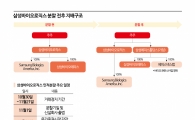
The recent spin-off and launch of a holding company by Samsung Biologics is expected to have a significant impact on Korea's bio ecosystem. There are expectations that Samsung Episholdings’ proactive investment and collaboration strategy, announced at its official launch, will lead to ecosystem revitalization and increased vibrancy in the capital markets.
According to the bio industry on November 21, Samsung Episholdings is jointly developing five new anti-cancer drug candidates with the domestic antibody-drug conjugate (ADC) development venture IntoCell, and has also signed a next-generation ADC therapy co-development agreement with China's Frontline Biopharma. Even before the split, the company had been strengthening collaboration in new modalities such as ADC. More recently, it has decided to work with Proteina, an AI-driven drug development company, to discover 10 new drug candidates based on AI by 2027.

The industry especially interprets the acquisition of pipeline and payload (drug) licenses as a forward-looking approach to new drug development investment. Going forward, Samsung Episholdings is expected to expand its investment focus beyond existing antibody drugs to include new modalities such as bispecific antibodies and ADCs. Collaboration with Samsung Biologics has become a major catalyst for attracting investor interest in the investment market. For example, Proteina, which is collaborating with Samsung Bioepis on AI drug development, saw its stock price rise by 285% within four months after its listing (July 29 this year), while IntoCell, a partner in the ADC field, rose about 78% after its listing (May 23 this year). These results demonstrate the power of the 'Samsung premium' in energizing the investment and capital markets.
The funding environment for domestic biotechs may also reach a turning point due to these changes. Until now, Korean bio startups have mainly raised funds through the stock market, such as technology-based IPOs or convertible bonds (CB). However, as the global economic downturn and interest rate hikes in 2022-2023 cooled bio investment sentiment, many companies faced clinical funding shortages. According to the Korea Venture Capital Association, venture capital (VC) investment in Korea’s bio and medical sectors peaked at 1.677 trillion won in 2021, but dropped sharply to 884.4 billion won in 2023. Last year, it remained at just 1.0695 trillion won, with only a weak rebound, raising concerns that 'bio VC funding has effectively dried up.'
If Samsung Bio's new drug development investment becomes full-scale, there are expectations that not only other pharmaceutical and biotech companies but also large corporations with strong financial resources will adopt a sequential investment model in promising biotechs, moving from 'equity investment → follow-up investment → acquisition.' In other words, rather than relying on one-off IPOs to raise funds for a single new drug as in the past, the industry structure could shift to attracting additional investment at each clinical stage as the company's value increases.
Lee Seungkyu, Vice Chairman of the Korea Biotechnology Industry Organization, said, "If Samsung expands investment and M&A both domestically and internationally, brings global alliances (partners and affiliates) into Korea, and enables domestic new drug technologies to be sold abroad, our pharmaceutical and bio industry will also become globalized. Samsung's transformation could also provide the motivation for existing pharmaceutical companies and financially strong companies from other industries to actively enter the bio market."
Celltrion, another major pillar of the domestic bio industry, is also rapidly accelerating its investment pace. Seo Jungjin, Chairman of the Celltrion Group, recently stated in an online briefing, "We are in substantive M&A discussions with one company and are competing with several global players," adding, "By the end of the year, it will become clearer who will make the acquisition." The company is also expanding its fund for open innovation. Chairman Seo has previously announced, "We have promised the government to expand the collaboration fund, currently managed at 500 billion won, to 1 trillion won by 2027." Earlier this month, Celltrion also licensed in two autoimmune disease treatments from U.S.-based Kyigen. The total contract, including milestone payments, amounts to 1.062 trillion won, which is seen as a symbolic case demonstrating Celltrion's intention to compete with global big pharma in the 'first-in-class' new drug segment.
The launch of Samsung Episholdings is also being evaluated as having come at an 'optimal time' for the qualitative leap of Korea's bio industry. ABL Bio's blood-brain barrier (BBB) shuttle 'Grabody-B', Alteogen's subcutaneous injection conversion technology 'ALT-B4', and Ligachem Bio's ADC platform have already proven the competitiveness of Korean platform technology through multi-trillion-won global technology exports. This trend has confirmed that platform-based businesses can be applied to various disease areas and, with relatively lower R&D costs, are advantageous for expanding global collaborations. At this juncture, Samsung Episholdings’ full-scale entry into platform development is expected to further solidify the domestic technology base and serve as a crucial foundation for expanding business into new drug and next-generation modality development.
Related Articles
 [Samsung Bio Spreads Its Wings] ① Laying the Foundation for a K-Drug Platform Like Roche and Novo
Jung Yuntaek, Director of the Pharmaceutical Industry Strategy Research Institute, said, "At this point of capital accumulation, the core strategies will be M&A, licensing, and venture investment. If Samsung moves, other large corporations will not stand still, and a capital competition could be triggered, bringing an investment boom across the domestic bio market."
© The Asia Business Daily. All rights reserved. Unauthorized AI training and use prohibited.