[Samsung Bio Spreads Its Wings] ① Laying the Foundation for a K-Drug Platform Like Roche and Novo
① Laying the Foundation for a K-Drug Platform Like Roche and Novo
Samsung Epis Holdings Officially Launched on the 1st
Relisting with Samsung Biologics on the 24th
Adding New Drug Development Capabilities to CDMO and Biosimilars
[Samsung Bio Spreads Its Wings] ① Laying the Foundation for a Korean New Drug Platform Like Roche and Novo
[Samsung Bio Spreads Its Wings] ② Exclusive Samsung Bioepis Begins Development of Enhertu Biosimilar
[Samsung Bio Spreads Its Wings] ③ Samsung’s Overhaul of Structure and Fundamentals: Will It Transform Korea’s Bio Ecosystem?
[Samsung Bio Spreads Its Wings] ④ Gaining More Attention Overseas... Revaluation and Foundation Laid
"The spin-off will enhance corporate transparency and improve performance." (John Rim, President of Samsung Biologics) "The launch of Samsung Epis Holdings is a turning point for a new leap forward in leading the global bioindustry." (Kim Kyunga, inaugural President of Samsung Epis Holdings)
On the eve of Samsung Group’s bio business spin-off, the two CEOs shared these ambitions. Through the spin-off of Samsung Biologics, Samsung Bio has officially embarked on a new path of growth. Samsung Biologics, reborn as a pure CDMO company, and its investment division, which was separated and officially launched as the holding company Samsung Epis Holdings on the 1st of this month, will be relisted on the KOSPI market on the 24th.

Pure CDMO and New Drug Development Platform... Now with Two Wings
According to the bio industry on November 21, the core of the Samsung Bio spin-off lies in shifting the business focus from quantitative growth, represented by CDMO and biosimilars, to qualitative growth through new drug development and investment expansion, thereby elevating its strategic level. Until now, Samsung Group’s bio division has concentrated on quantitative growth, centered on the two business areas of CDMO and biosimilars. As a result, it is expected to surpass 6 trillion won in revenue and 2 trillion won in operating profit (combined) this year, just 14 years after its founding. The compound annual growth rate (CAGR) of 40.79% over the past eight years is unrivaled within Samsung Group, demonstrating that Samsung Bio has established itself as a major 'cash cow' within the group. This spin-off marks the first step toward a new 'quantum leap.'

Following the spin-off, Samsung Biologics will operate as a pure CDMO company, focusing on increasing productivity and enhancing quality. Through this, Samsung Biologics aims to eliminate concerns about conflicts of interest among its clients and further expand orders from global pharmaceutical companies. This year, Samsung Biologics has strengthened its business not only in contract manufacturing (CMO) but also in contract development (CDO) and contract research (CRO) services, actively attracting clients at the early clinical stage. The strategy is to broaden client engagement and initiate collaboration from the early stages, thereby reinforcing the client 'lock-in effect.' In addition, the company plans to create a significant lead in global pharmaceutical manufacturing by operating its antibody-drug conjugate (ADC) production line and securing a production capacity of 1,324,000 liters by 2032.
Samsung Epis Holdings will leverage its accumulated biosimilar development capabilities to expand into the new drug sector, serving as a platform for investment and pipeline development. Samsung Epis Holdings will make Samsung Bioepis a wholly owned subsidiary and has established a new subsidiary, Epis Nexlab, to drive future bio growth businesses. This new entity aims to build a platform encompassing various modalities such as peptide conjugates, bispecific antibodies, and ADCs, to discover promising new drug candidates and pursue joint development with global pharmaceutical companies, embodying a 'biotech-style' model. Samsung Epis Holdings is positioning itself as a platform company that integrates various technologies and partners into a single growth engine.
'Big Pharma' Now Buys Innovative New Drugs... Why Platform Functions Matter

This vision aligns with global trends in the pharmaceutical industry. In the past, a pharmaceutical company’s competitiveness was measured by how well it conducted new drug research and development (R&D). Now, however, it is an era where players with significant capital and platform power dominate the ecosystem. Large pharmaceutical companies with steady cash flow are filling their new drug pipelines by investing in or acquiring promising startups, leveraging their existing capital and cash cows. Steve Sugino, Vice President of Bristol Myers Squibb (BMS) Asia-Pacific, said, "More than half of BMS’s current pipeline comes from external innovation, such as partnerships and technology transfers. Innovation in new drugs through artificial intelligence (AI) is an even greater opportunity for startups and biotechs, and it is also a core part of BMS’s management."
The cases of Roche and Novo Nordisk best illustrate the changes in the global pharmaceutical industry. Roche Holdings, the holding company of the Roche Group, secures stable cash flow from its pharmaceutical and diagnostics subsidiaries, while boldly acquiring new pipelines through mergers and acquisitions (M&A) when necessary. Novo Holdings has also evolved into a specialized bio-investment holding company, investing in life science companies worldwide with the massive dividends it receives from Novo Nordisk, which developed obesity treatments. Last year alone, it incorporated 43 new biotechs and completed 27 investment exits, and it also executed a mega-deal by acquiring the US CDMO company Catalent for 16.5 billion dollars (about 24 trillion won). In the so-called 'Roche Holdings and Novo Holdings model,' the holding company functions as a platform that simultaneously manages R&D and M&A based on a stable cash cow.

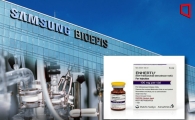
Exterior view of Samsung Bioepis headquarters in Songdo, Incheon. Samsung Bioepis
View original imageLee Seungkyu, Vice Chairman of the Korea Biotechnology Industry Organization, stated, "Although Korea’s pharmaceutical history exceeds 100 years and it is one of the world’s top 10 economies, we do not have a global 'big pharma.' It is positive from an ecosystem perspective for a company with strong financial resources to play a platform role, covering CDMO, new drugs, biosimilars, and investment." He added, "The bioindustry, especially the new drug sector, requires capital and global networking, and large corporations like Samsung can help enhance global competitiveness."
© The Asia Business Daily. All rights reserved. Unauthorized AI training and use prohibited.