Samsung Electronics Robotics Subsidiary to Launch Industrial Humanoid Robot Next Year
RB-Y2 with Enhanced Payload over RB-Y1
Preparing Safety Certification for Industrial Deployment
Dozens of Previous Models Supplied to Research Institutes
Korean Government and Companies Accelerate Robot Commercialization
Rainbow Robotics, a robotics subsidiary of Samsung Electronics, plans to launch an industrial dual-arm humanoid robot next year. Until now, Rainbow Robotics has produced dual-arm robots primarily for research purposes, but with the decision to deploy them in manufacturing sites, the company is ushering in a new era of commercialization.
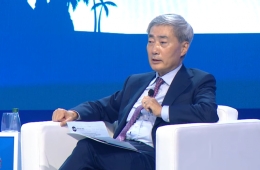
Heo Jungwoo, Chief Technology Officer (CTO) of Rainbow Robotics, stated in an interview with Asia Economy at the 2nd Future Strategy Forum held at the Fairmont Hotel in Yeongdeungpo-gu, Seoul on the 29th, "We are preparing to launch the industrial robot RB-Y2 next year."

The RB-Y2 is an upgraded model of the RB-Y1, which Rainbow Robotics released in March last year. The RB-Y1 is a mobile dual-arm robot equipped with wheels and two arms, featuring dual arms with seven degrees of freedom each, a single-leg structure with six degrees of freedom, and a 'Mecanum wheel system' that allows movement in all directions. The dual arms have seven joints each, enabling human-like multi-directional movement, while the leg is equipped with six joints. The wheels allow for forward, backward, lateral, diagonal movement, and even on-the-spot rotation.
Designed as a research platform, the RB-Y1 has mainly been supplied to academia and research institutes for use in various experimental environments, including artificial intelligence (AI) training, object recognition, and manipulation (object grasping). Global companies such as Amazon, EKA Robotics, Microsoft, and Assured Robot Intelligence have also adopted the RB-Y1 for their research and experiments.
While the RB-Y1 was primarily supplied for academic and research purposes, the RB-Y2 is aimed at deployment in industrial sites. The new model has enhanced payload capacity-the maximum load the robot can lift-and is set to receive collaborative robot interface (UI) safety certification by applying software based on a standard platform. This will ensure that the robot meets the requirements for immediate use in industrial settings. Hardware development has already been completed, and work is underway to finalize the software and certification systems.
CTO Heo commented, "For the RB-Y2 to be applied in industrial sites, safety certification and software refinement are necessary," adding, "Although the hardware is already completed, we are currently adjusting functions to match actual industrial demand." He further noted, "Manipulation, or the robot's ability to grasp and handle objects with its hands, remains a challenge."
He identified price and component competitiveness as obstacles to mass production of industrial robots. CTO Heo said, "Price competitiveness is crucial for large-scale deployment of robots in industrial sites," expressing concern that "China can mass-produce hardware at low cost, which could put domestic component manufacturers at a disadvantage." He continued, "Government support should go beyond simple research funding and focus on nurturing key component manufacturers," emphasizing that "for precision parts such as core sensors or robot hands, price disparities can be dozens of times higher, making them the weakest link in global competition."
As global robot manufacturers race to commercialize humanoid robots, domestic manufacturers are also accelerating the launch of robots for commercialization. CTO Heo explained, "More products are expected to be released next year." Hyundai Motor Group, which acquired Boston Dynamics, plans to deploy its humanoid robot 'Atlas' at Hyundai Motor factories by the end of this year. Robotis also plans to supply its self-developed humanoid robot and robot hand to OpenAI within this year.
Hot Picks Today
 "I Ate It Often Because It Tasted Good"... This Eating Habit Linked to 40% Higher Odds of Asymptomatic Cerebrovascular Damage
- "Booked a Cheap Flight, Only to Get Blindsided"... Travelers' Complaints "Explode" Over Extra Fees
- Woman in Her 70s Assaults Sister in Her 80s: “She Had an Affair with My Husband”
- “Dad Just Gave It to Us as a Gift”... Scratched a Lottery Ticket at a Family Gathering and Hit a 1 Billion Won Jackpot
- "We've gone this far to save on lunch"... Where office workers are flocking instead of restaurants
The government is also making a concerted effort to commercialize humanoid robots. The 'Manufacturing Artificial Intelligence Transformation (AX) Alliance,' launched this month by the Ministry of Trade, Industry and Energy and the Korea Chamber of Commerce and Industry, announced plans to mass-produce more than 1,000 humanoid robots annually starting in 2029.
© The Asia Business Daily. All rights reserved. Unauthorized AI training and use prohibited.

!["Please, Just Take Them Off" - They Made It All the Way to Bed... Then Fecal Bacteria Struck [Deep Scroll]](https://cwcontent.asiae.co.kr/asiaresize/307/2026101610053063338_1792112730.png)