Slight Increase in Competition Rates for Regular College Admissions at Major Universities in Gwangju and Jeonnam
'Average Competition Rate' Chonnam National University 4.11:1... College of Medicine 7.05:1
Chosun University 5.83:1... Pre-med General Admission 5.58:1
Gwangju Institute of Science and Technology 72.53:1, Korea Energy Engineering University 28.1:1
Dongshin University College of Korean Medicine 10.29:1, Gwangju National University of Education 2.66:1
As the application period for the 2025 regular university admissions has closed, the competition rates at major universities in the Gwangju and Jeonnam regions have been recorded as similar to or slightly higher than last year.
According to universities in the Gwangju and Jeonnam area on the 6th, Chonnam National University received 5,792 applications for 1,410 available spots, resulting in a competition rate of 4.11 to 1.
This is similar to last year's rate of 4.17 to 1. Among them, the Gwangju campus recorded a rate of 5.17 to 1, while the Yeosu campus had a rate of 1.91 to 1.
The highest competition rate was for the College of Education (general admission) at the Gwangju campus, with 33 applicants for 3 spots, resulting in a rate of 11 to 1. At the Yeosu campus, the Creative Convergence Department (Group B) had 25 applicants for 1 spot (25 to 1), and the Japanese Studies major had 12 applicants for 1 spot (12 to 1).
For the integrated bachelor's and master's program in dentistry (general admission), 42 applicants competed for 4 spots, resulting in a rate of 10.5 to 1. For the local talent track, 42 applicants competed for 8 spots, resulting in a rate of 5.25 to 1.
For the medical school, the general admission in Group A had 141 applicants for 20 spots (7.05 to 1), and the local talent track had 121 applicants for 25 spots (4.84 to 1).
On the other hand, some departments in the College of Arts and certain early employment contract departments did not reach their quota of applicants.

At Chosun University, the overall competition rate for regular admissions was 5.83 to 1, with 2,812 applicants for 482 spots. This is higher than last year's rate of 3.48 to 1.
The highest competition rate was for the Liberal Arts Department, with 62 applicants for 2 spots (31 to 1). For the pre-medical course, 262 applicants competed for 56 spots (4.7 to 1).
For the pre-medical general admission, 134 applicants competed for 24 spots (5.58 to 1); for the local talent track, 113 applicants competed for 28 spots (4.04 to 1); and for the local opportunity balance track, 15 applicants competed for 4 spots (3.75 to 1).
For the early admissions at the medical schools of both universities, which closed last month, Chonnam National University had 120 registrants out of 121 available spots, resulting in 1 spot being carried over to the regular local talent track.
At Chosun University, 94 out of 98 early admission spots for the pre-medical course were filled, resulting in 4 spots being carried over to the regular local balance track.
Gwangju Institute of Science and Technology (GIST) had a high competition rate of 72.53 to 1, with 1,088 applicants for 15 spots. Korea Institute of Energy Technology had 281 applicants for 10 spots, resulting in a competition rate of 28.1 to 1.
At Gwangju National University of Education, 255 applicants competed for 96 spots in the Group B track, resulting in a rate of 2.66 to 1.
Additionally, Gwangju University recorded a rate of 1.19 to 1, Gwangju Women's University 1.46 to 1, Nambu University 1.14 to 1, Songwon University 0.99 to 1, and Honam University 1.5 to 1, barely exceeding or falling short of their quotas.
At Dongshin University, the Group A track, which includes the Korean Medicine Department, saw a competition rate of 10.29 to 1. However, in the Group D track, which includes general departments, the rate was 0.96 to 1, falling short of the quota.
Hot Picks Today
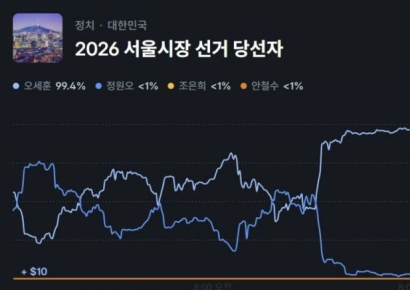 Foreign Investors Lament Huge Losses in an Instant as Oh Sehoon Overtakes Jeong Wonoh in Seoul Mayoral Election Bets
- "Ballot Boxes Must Leave to Confirm Oh Sehoon," Authorities Say, but "Re-vote Needed"—Jamsil 7-dong Blocks Vote Counting
- Lee Jaemyung Effect, Real Estate, and Changing Yeongnam: Three Key Factors That Shaped the June 3 Local Elections
- Exit Polls Miss the Mark Again: Major Errors in Broadcasters' Projections Despite Predicted 8.6% Lead
- Oh Sehoon Achieves Dramatic Comeback in Fierce Battle... June 3 Local Elections: Democratic Party Wins 12 to 4
© The Asia Business Daily(www.asiae.co.kr). All rights reserved.