[The Editors' Verdict] The Current Status of the Stock Company Republic of Korea
Urgent Need for Institutional Improvements to Level Up the Capital Market
4600 trillion won VS 2700 trillion won. Is this a comparison between the market capitalization of the U.S. stock market and the Korean stock market? Unfortunately, it is not. It is the market capitalization of Nvidia in the U.S. versus the market capitalization of the entire Korean stock market (KOSPI + KOSDAQ + KONEX). The entire Korean market cannot catch up to just one U.S. company. There are as many as six companies in the U.S. market with a market capitalization larger than the entire market capitalization of Korea. Some may try to console themselves by attributing this to the difference in the size of the countries. Then, let’s compare with Taiwan. Currently, Taiwan’s stock market capitalization has surpassed 3000 trillion won, which is 300 trillion won more than Korea. Given this situation, can we complacently think it is just due to the difference in country size?

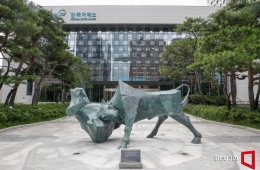
Kim Joo-hyun, Chairman of the Financial Services Commission, is delivering a congratulatory speech at the '1st Seminar on Support Measures for Corporate Value-Up to Boost the Korean Stock Market' held at the Korea Exchange in Yeouido, Seoul. Photo by Kang Jin-hyung aymsdream@
View original imageThere is a term investors always hear: Korea Discount. The Korean stock market is uniquely undervalued. Why is the corporate value not fully recognized? It is because foreign and domestic institutional investors, who have a significant influence on the stock market’s supply and demand foundation, do not find the Korean market attractive. Therefore, the answer to the discount must be found in why the “stock company Republic of Korea” is not seen as an attractive investment market. First, there are significant concerns about uncertainty in the political and economic systems.
Recently, Korea’s inclusion in the Morgan Stanley Capital International (MSCI) Developed Markets (DM) index failed again this year. The sudden ban on short selling was the cause. MSCI pointed out, “The full ban on short selling implemented in November last year is expected to be temporary, but sudden changes in market rules are undesirable.” To attract foreign investors, the government needs to maintain correct and consistent policies aimed at a developed capital market. If economic growth is not supported like in India, at least a stable political and economic system must be established so that the current value can be properly evaluated.
Domestic institutional investors are reducing their domestic investment proportions and increasing overseas investments. Since they must focus on returns, they have judged that the undervalued domestic market offers no solution. The largest “big hand,” the National Pension Service (NPS), has had an average annual domestic stock investment return of about 6.3% since its fund establishment in 1988, but its overseas stock investment return is nearly double at 11%. This is not due to poor investment performance in the domestic market but rather a fundamental problem with the market itself failing to generate high returns. Moreover, due to the failure of pension reform, the NPS has decided to reduce its domestic stock investment ratio from the current 14.2% to 13% by 2029.
Hot Picks Today
 "Two Spend 500,000 Won in a Flash, Yet Wait Two Hours?" ... 'Dreamland' Shunned by Kids and Foreign Tourists
- The Era of Getting 200 Million Won After 30 Years Is Over... A Japanese Bank's "Perpetual Department Head" Who Just Clocked In Cries Out
- Spain Hit by Its Worst Tragedy... Lee Kangin, Moreno and Real Madrid Join Soccer World in Mourning
- They Said, “Make It Your Home for Life” - Then Suddenly Kicked 200 Passengers Off... What Happened to the Around-the-World Cruise?
- "130 Rice Bowls Sold Out in a Day"... 'Unfiltered Face' Adds 8 Million Won to Night Market Sales: China's Bungeunwoo
Individual investors are also focusing on overseas investments, and it will not be long before their overseas investment proportion surpasses domestic investment. This year, individuals have sold about 11 trillion won worth of domestic stocks and instead purchased 8 trillion won worth of U.S. stocks. The amount of U.S. stocks held by individuals has now exceeded 80 billion dollars, growing tenfold compared to five years ago.

Various indices are displayed on the electronic board in the dealing room of the Seoul Hana Bank headquarters. Photo by Huh Younghan younghan@
View original imageThis year, the government has been working hard to promote value-up efforts to resolve the Korea Discount. Recently, the KOSPI has been gaining strength, reaching the 2800 level, but there is still a long way to go. Institutional improvements are needed to level up the capital market. Efforts must be made to push forward a combination of policies such as amendments to the Commercial Act stipulating directors’ fiduciary duties to shareholders, investor protection mechanisms safeguarding minority shareholders’ rights, long-term investment tax incentives, separate taxation on dividends, reexamination of financial investment income tax, and corporate governance improvements. The choice of individuals and institutions to go overseas in pursuit of higher returns is rational. To hold their feet, the market must change. To attract foreigners, it must be shown that the investment environment of the stock company Republic of Korea has changed. This is for the survival of the Korean stock market.
© The Asia Business Daily. All rights reserved. Unauthorized AI training and use prohibited.