SKC to Receive US Government Semiconductor Subsidy... First Materials and Components Company
Signed Preliminary Transaction Agreement for $75 Million Payment
Targeting Glass Substrate Plant 1 Under Trial Operation
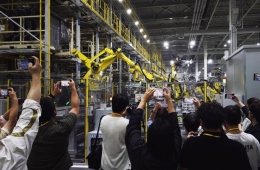
Absolics, a subsidiary of SKC, will receive semiconductor subsidies exceeding 100 billion won from the U.S. government. This is the first case of a semiconductor materials and components company receiving subsidies from the U.S. government.

On the 23rd (local time), the U.S. Department of Commerce announced that it signed a Preliminary Memorandum of Transaction (PMT) to provide Absolics with $75 million (approximately 101.5 billion won) in semiconductor production support funds under the CHIPS Act.
The subsidy recipient is Absolics' Covington glass substrate Plant 1 located in the state of Georgia. The subsidy Absolics receives accounts for 25% of the total investment cost of $300 million.
Plant 1 was recently completed and has started trial operations, with an annual production capacity of 12,000㎡. The commercial mass production is scheduled for the first half of next year. Absolics also plans to build Plant 2, which will have an annual production capacity of 72,000㎡. It is expected to invest more than $400 million in this project.
Hot Picks Today
 "Just Two Days of Work Equals a Month's Salary"... Where Young Cubans Are Flocking After Abandoning Their Livelihoods
- Who Is the Twenty-Something Man Who Blew $800,000 a Day on Ferraris and Hermes Bags in Nightclubs?
- KOSPI Plummets to 6,800 at the Open... KOSDAQ Also Drops
- Wiped Out 30 Million Won in 2 Minutes and 30 Seconds... Unexpected 'Luxury Items' Targeted by Thieves
- "Never Seen Anything Like This in My Life, Shocked" Feces Discovered in the Middle of Jamsil Baseball Stadium Passage
In 2021, SKC established Absolics, a joint venture with semiconductor equipment company Applied Materials (AMAT), specializing in glass substrates for semiconductor packaging. Glass substrates are a product that Absolics is pioneering for commercialization worldwide. Unlike existing semiconductor substrates that use plastic, these use glass as the raw material. This can reduce power consumption by more than 30% compared to conventional substrates and also increase data processing speed.
© The Asia Business Daily. All rights reserved. Unauthorized AI training and use prohibited.