[2022 National Audit] UHD Broadcasting Consuming Subscription Fees... "Need for Funding Reallocation" Highlighted
Concerns Raised by Lawmakers Jeong Pil-mo and Park Wan-joo
Regarding the Sustainability of UHD Broadcasting

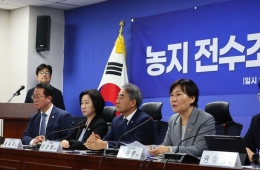
At the National Assembly's Science, Technology, Information and Broadcasting Committee's audit of the Korea Broadcasting System (KBS) held on the 17th, the issue of UHD (ultra-high-definition) broadcasting was raised. The photo shows Jeong Pil-mo, a member of the Democratic Party of Korea, questioning KBS President Kim Ui-cheol. Photo by Jeong Pil-mo
View original image[Asia Economy Reporter Minyoung Cha] At the National Assembly Science, Technology, Information and Broadcasting Communications Committee’s audit of the Korean Broadcasting System (KBS) held on the 17th, the issue of UHD (Ultra High Definition) broadcasting was brought to the forefront. UHD broadcasting, introduced as a next-generation terrestrial broadcasting service policy by the Korea Communications Commission and the Ministry of Science and ICT, is a recurring topic criticized annually during the audit.
Jeong Pilmo, a member of the Democratic Party of Korea, pointed out, "The direct reception rate of terrestrial UHD service has dropped to the 2% range, so I think it might be better to invest in next-generation mobile services," adding, "In the case of UHD, most people receive it through cable TV or satellite TV even if they do not receive it directly, so I question whether there is a need to have communication facilities that enable direct reception."
Park Wanju also stated, "There is only one UHD relay vehicle, and none in other regions," and asked, "The Korea Communications Commission has said it will conduct a comprehensive review of UHD policy over the past five years. Should we continue UHD broadcasting, or, as Jeong Pilmo suggested, conduct an appropriate evaluation and reallocate UHD resources to other areas?"
The direct reception rate of terrestrial UHD has been declining annually, independent of the spread of UHD TVs. The direct reception rate of terrestrial UHD broadcasting decreased from 5.3% in 2017 to 4.2% in 2018, 2.6% in 2019, 2.3% in 2020, and 2.2% in 2021. The household UHD TV ownership rate slightly increased by 4.4% from 10.3% in the previous year to 14.7% last year, but there remains the issue that viewers must install a set-top box or watch through paid broadcasts such as IPTV or cable TV, which retransmit terrestrial UHD broadcasts.
When KBS President Kim Eui-cheol was asked about continuing investment in UHD broadcasting, he replied, "Social consensus and policy agreement are necessary." In response, Park Wanju questioned, "Isn’t KBS also in a situation where it lacks the capacity to invest?"
According to Park Wanju’s office, KBS’s total revenue has stagnated over the past 10 years. From 2012 to 2021, KBS’s compound annual growth rate (CAGR) of revenue was -0.5%. Revenue decreased from 1.519 trillion won in 2012 to 1.458 trillion won in 2021. Although the main source of income, the license fee, slightly increased, advertising and sponsorship revenues all declined.
Hot Picks Today
 "I Went for the Cheap Coffee, but Now I Feel Uneasy"... Major Coffee Franchises Cited for Violations One After Another
- "Yeosu City Under Fire for Official Notice Targeting Taxi Drivers over 'Malicious Rumors' about Islands Expo"
- In Korea, Studying Medicine Is in High Demand, but in China, It's Shunned: "Why Become a Doctor When You Can’t Make Money?"
- "50 Million Won for Weekly Encounters"... Man in His 60s Sentenced for Deceiving Woman in Her 20s with Forged 1.4 Billion Won Account
- "After Spending 170,000 Won on Hanwoo, This Is What I Got": Why Webtoon Artist Kim Gyusam Decided to Give Cash Instead
Meanwhile, the Korea Communications Commission had planned to build a nationwide broadcasting network since the introduction of terrestrial UHD in 2017, but postponed it to next year due to the deteriorating financial conditions of local broadcasters.
© The Asia Business Daily. All rights reserved. Unauthorized AI training and use prohibited.