Icarus's Dream... China Launches Another Solar Exploration Satellite
Kwafu, 720 km Altitude Solar Explosion, Magnetic Field, Corona 24-Hour Observation
US Parker Probe Groundbreaking but Telescope Observation Difficult Due to Solar Temperature
[Asia Economy Senior Reporter Cho Young-shin] China's second solar exploration satellite has been successfully launched.

Chinese media, including Xinhua News Agency, reported that at 7:43 a.m. on the 9th (local time), the solar observation satellite "Kua Fu 1" launched from the Jiuquan Satellite Launch Center in Gansu Province successfully entered its planned orbit.
Kua Fu is a giant from ancient Chinese mythology who chased the sun and died of thirst after drinking all the water of the Yellow River. It carries a meaning similar to Icarus from Greek mythology.
Last year, on October 14, China launched its first solar exploration satellite "Xihe" (a woman who gave birth to the sun in ancient Chinese mythology) into an orbit at an altitude of 517 km from the Taiyuan Satellite Launch Center in Shanxi Province.
Chinese media attributed significance to Kua Fu as China's first comprehensive solar observatory. Kua Fu is expected to observe the sun's magnetic field, solar flares caused by solar explosions, and coronal mass ejections 24 hours a day at an altitude of 720 km for the next four years.
While the Xihe satellite was equipped only with solar flare observation equipment (H-alpha spectrum) and could observe only the light emitted by hydrogen atoms, Kua Fu can monitor various solar activities.
Chinese media reported that after a testing period of 4 to 6 months, Kua Fu will carry out its official solar exploration mission between February and April next year. Additionally, Kua Fu is expected to collect about 500GB of data daily and transmit it to the China Space Observation Center, with China planning to make the data available to scientists worldwide.
Chinese media cited Chinese space experts claiming that Kua Fu can observe solar activity more continuously than NASA's Parker Solar Probe, which was launched in 2018.
Gan Weiqu, a researcher at the Zijinshan Astronomical Observatory in Nanjing, pointed out, "The US Parker Solar Probe is groundbreaking in that it flies close to the sun to observe solar activity, but its telescope equipment cannot withstand heat above 5,000 degrees Celsius, so Parker cannot observe the sun directly 24 hours a day." NASA announced at the end of last year that the Parker Solar Probe reached the sun's surface at a temperature of 1,111,093 degrees Celsius.
Hot Picks Today
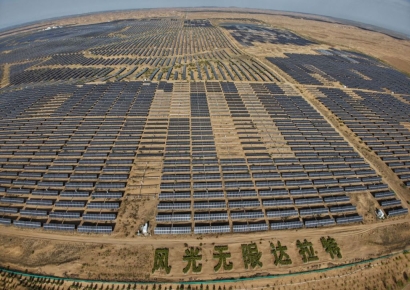 "After Dominating 80% of the Global Market... China’s Solar Industry Hit with 3 Trillion Won Losses"
- Closing Gap with Samsung and SK hynix: "Shares Surge Fivefold on Debut" as China's DRAM Giant CXMT Sweeps Up 14 Trillion Won
- Yoon Faces Forfeiture of Presidential Victory in First Trial for Election Law Violation... People Power Party May Have to Repay 39.7 Billion Won if Finalized
- After Queue-Jumping Incident, Foreign Passenger Spotted Vaping in Incheon Airport Security Area
- "One Sip Has Koreans Lining Up for Four Hours... The Remarkable Turnaround of the 1993-Born Chairman [Interview]"
Chinese media emphasized that the sun's cycle is 11 years and that solar activity will peak between 2024 and 2025, highlighting that Kua Fu, as China's first comprehensive solar observatory, will greatly aid research on long-term solar cycles and solar storms.
© The Asia Business Daily. All rights reserved. Unauthorized AI training and use prohibited.