Why UK 'ARM' Appears on the M&A Table Between Korean and Japanese Companies

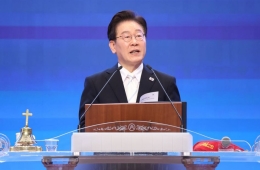
Samsung is making headlines by entering the semiconductor company ARM acquisition battle. Photo by Song Hyundo, Asia Economy intern reporter.
View original image[Asia Economy Intern Reporter Song Hyundo] ARM (Acorn/Advanced RISC Machines), a UK-based semiconductor design company rumored to be a potential acquisition target for Samsung Electronics, is a fabless company specializing in designing smartphone processors. Located in Cambridge, UK, its parent company is Acorn Computers.
In the mid-1980s, Sophie Wilson, founder of Acorn Computers, developed a CPU (Central Processing Unit) for the high-performance business computer 'Archimedes' together with Steve Furber, a fellow Cambridge University alumnus, creating a microprocessor design technology called 'Acorn RISC Machine.'
Later, Apple decided to adopt this microprocessor technology for its Newton series, the precursor to the iPad, leading Acorn Computers and Apple to establish a joint venture in Cambridge, UK, in November 1990. This marked the beginning of the company named 'ARM,' derived from the initials of the technology.
A Company Co-Founded by Apple, Rapid Rise with the Advent of Smartphones
ARM's growth is closely linked to the spread of smartphones. Since 2005, ARM diversified its CPU product lineup, which allowed it to present the 'Cortex-A,' a CPU optimized for smartphones, as its main product, beginning to influence the semiconductor industry broadly. The share of application processors (APs) using ARM's design technology in smartphones approaches 95%. Furthermore, with the full-scale commercialization of 5G and the widespread adoption of Internet of Things (IoT) devices, the importance of ARM technology optimized for AI is increasing. The current estimated corporate value ranges from $40 billion to $60 billion, approximately 56 to 85 trillion KRW. Major clients include Samsung Electronics, Apple, Qualcomm, and Google.
ARM, which was thriving, was acquired in 2016 by Japan's IT investment firm SoftBank for ?23.4 billion (33.5 trillion KRW). SoftBank holds 75% of the shares, while the remaining 25% is owned by its subsidiary venture capital fund, the 'SoftBank Vision Fund.' The Vision Fund is also the largest shareholder of Coupang.
SoftBank Chairman Son Jeong-hee acquired ARM at a price 43% higher than the market capitalization, expressing satisfaction by saying, "In 10 years, we will think this price was a bargain." Indeed, ARM became the so-called 'goose that lays golden eggs,' holding a 90% market share in mobile chip design and 85% in tablet design.
However, facing a crisis due to consecutive investment losses, SoftBank eventually decided to sell ARM. The company that came closest to acquiring it in 2020 was the US semiconductor firm NVIDIA. NVIDIA agreed to acquire ARM for about $40 billion, including $10 billion in cash and $21.5 billion in NVIDIA stock. However, competitors such as Qualcomm strongly opposed the deal, arguing that NVIDIA could act as a gatekeeper by blocking technology access. In February this year, the acquisition was ultimately blocked by antitrust authorities in the US and UK. After the NVIDIA deal fell through, SK Hynix showed signs of forming a consortium with other companies to jointly acquire ARM. SK Hynix Vice Chairman Park Jeong-ho revealed such plans at the annual shareholders' meeting held in March this year.
ARM, a Perfect Puzzle Piece for Samsung, Must Overcome Competitors' Opposition
![[Image source=Yonhap News]](http://www.asiae.co.kr/news/img_view.htm?img=2022092211240442371_1663813444.jpg)
Intel and Qualcomm are also interested in acquiring ARM. Cristiano Amon, CEO of Qualcomm, stated, "As an interested party in investment, we can collaborate with other chip manufacturers for the acquisition." Samsung Electronics is no exception. Attention is focused on the meeting between Samsung Electronics Vice Chairman Lee Jae-yong and SoftBank Chairman Son Jeong-hee next month, as this decision could be a 'game changer' that compensates for Samsung's semiconductor business weaknesses.
If Samsung Electronics, the world leader in memory semiconductors, secures ARM's semiconductor design technology as well, it could seek a breakthrough toward achieving the goal of becoming the number one system semiconductor company by 2030. According to a 2020 IC Insights survey, Korea's fabless sales share is only 1%, significantly lagging behind the US (64%), Taiwan (18%), and China (15%).
Hot Picks Today
 Panic as Scores Jump from 72 to 92... "AI Glass...
- "Samsung Takes the Lead"…Tension Rises in Taiwan as Dominance Shows Signs of Cr...
- [Breaking] Democratic Party Jeonnam-Gwangju Primary: Min Hyungbae and Kim Youngr...
- "Is It Just a Migraine?" Ignoring This May Lead to Stroke... Seek Medical Help I...
- "Stop Coming, Koreans"... Japanese Residents Frustrated as Korean Drama Fuels Ov...

However, considering the failed NVIDIA acquisition, dispelling concerns about monopolies is crucial. The speculation that Chairman Son will propose a joint acquisition of ARM to Vice Chairman Lee is based on this context. The idea is for Samsung Electronics to form a consortium with other semiconductor companies to acquire ARM, thereby resolving monopoly issues. Since the interests among semiconductor companies are sharply divided, the consortium centered around Samsung Electronics and ARM is expected to take on the character of a kind of 'semiconductor alliance.'
© The Asia Business Daily(www.asiae.co.kr). All rights reserved.