Why NASA in the US is Anxious About the Launch of Korea's Lunar Probe [Reading Science]
![Why NASA in the US is Anxious About the Launch of Korea's Lunar Probe [Reading Science]](http://www.asiae.co.kr/news/img_view.htm?img=2022072514182462631_1658726304.png)
[Asia Economy Reporter Kim Bong-su] "We will examine the Moon's permanently shadowed regions in detail with performance 200 times superior to that of American satellites."
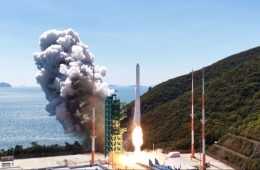
Astronomers worldwide, including those in the United States, are showing great interest in South Korea's lunar probe 'Danuri' launch. This is because it enables the collection of lunar surface data with much higher precision than before.
On the 26th (local time), the U.S. space media Space.com reported, "South Korea's first lunar exploration mission launch is just one week away. Danuri (KPLO) is scheduled to be launched on SpaceX's Falcon 9 on the 2nd of next month," adding, "This launch marks the first step in South Korea's ambitious deep space exploration, which includes a lunar landing probe launch planned for 2030 and asteroid sample collection."
The media briefly explained the scientific experiments to be conducted by Danuri's six payloads, focusing especially on the permanently shadowed region camera (Shadowcam) developed by NASA. According to the report, NASA announced plans in 2016 to develop scientific equipment capable of enhancing knowledge about the distribution of volatile substances, including water, presumed to be buried in the Moon's shadowed areas (permanently shadowed regions) where human exploration has not yet been conducted. Subsequently, NASA developed Shadowcam through Arizona State University and a private company based in San Diego, California. This camera is designed to capture images of the Moon's permanently shadowed regions, where there is almost no light, using high-resolution sensors, cameras, and telephoto lenses.
In particular, Shadowcam is designed similarly to the camera mounted on the Lunar Reconnaissance Orbiter (LRO) launched by the U.S. in 2008, but its performance is about 200 times better. Professor Prasun Mahanti of Arizona State University explained, "The Moon's permanently shadowed regions have very low temperatures, allowing volatile substances such as water, ammonia, and methane to remain buried for long periods." He added, "Although images can only be captured using ambient reflected light due to the absence of direct light, Shadowcam is much more sensitive than the camera attached to the LRO, so we expect to take the first high-resolution photos of the Moon's permanently shadowed regions."
Ben Bush, a researcher at Johns Hopkins University's Applied Physics Laboratory, explained that Shadowcam's goal is not only to map the Moon's south and north poles and search for water but also to provide data necessary for selecting landing sites for the upcoming Artemis lunar landing project. He said, "Another goal is to check for obstacles inside the permanently shadowed regions and paths that people or rovers can traverse." He pointed out, "Exploring these areas is never easy, so the more data Shadowcam can collect, the more efficiently the exploration can be conducted."
Researcher Bush also praised Danuri and the Korean development team. He said, "The Korean Danuri team has many very interesting payloads on their first lunar orbiter," adding, "We have enjoyed collaborating with them."
Hot Picks Today
 "Expensive, Smelly and Scary"... What's Happened to the "Honeymooners' Paradise" Tourists Have Abandoned?
- Women Who Say "A Husband's Annual Salary of 100 Million Won Is a Given"... Matchmaking CEO: "They Talk About It Like It's Nothing"
- "I Want to Eat Like Koreans..." Foreigners Who Once Opened Ramen Packs Now Keep Gochujang in Their Pantries
- [Tomorrow's Weather] Wednesday: 5-10 Degrees Lower Than Yesterday... Beware of Chilly Mornings and Big Day-Night Temperature Swings
- "I'll Give You 53.4 Billion Won to Keep Quiet"... Influencer Reveals Secret Deal; Musk Denies It
Meanwhile, NASA is conducting the international cooperative space development project 'Artemis' program with about ten countries, including South Korea. As part of this, the second human lunar landing exploration is scheduled to take place after 2025. NASA plans to send astronauts and rovers to the Moon's south pole, part of the permanently shadowed regions, to directly verify the presence of water.
© The Asia Business Daily. All rights reserved. Unauthorized AI training and use prohibited.