Prosecutors' Office Rebutts Supreme Prosecutors' Office Claim of "No Legal Basis for Case Handling Rules," Escalating Conflict Between Two Agencies

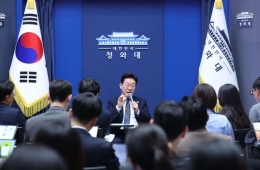
On the 16th, Kim Jin-wook, Chief of the High-ranking Officials' Crime Investigation Agency (Gong-su-cheo), answered questions from reporters as he arrived at the Gong-su-cheo office in the Government Complex Gwacheon.
[Image source=Yonhap News]
[Asia Economy Reporter Choi Seok-jin] The conflict between the High-ranking Officials' Crime Investigation Office (HCIO) and the prosecution over the HCIO's procedural rules, which explicitly stipulate 'referral with prosecution rights reserved,' is intensifying.
On the 4th, the HCIO issued a statement titled "Regarding the Supreme Prosecutors' Office's Position on the HCIO Procedural Rules," rebutting point by point the Supreme Prosecutors' Office's statement released that day claiming "the HCIO procedural rules have no legal basis."
First, the HCIO responded to the Supreme Prosecutors' Office's claim that "the HCIO procedural rules have no legal basis" by stating, "The HCIO procedural rules are based on Article 45 of the HCIO Act and have effect equivalent to a Presidential Decree."
Article 45 (Organization and Operation) of the HCIO Act stipulates that "matters necessary for the organization and operation of the investigation office, other than those specified in this Act, shall be prescribed by the investigation office's rules."
Regarding the Supreme Prosecutors' Office's claim that the rule requiring judicial police officers to apply for warrants to the HCIO concerning corrupt prosecutors conflicts with the Criminal Procedure Act, the HCIO rebutted, saying, "Prosecution rights were granted to the HCIO to prevent prosecutors from protecting their own members," and added, "The Supreme Prosecutors' Office's argument implies that warrants for prosecutor misconduct should be applied for by the prosecution, which contradicts the HCIO Act's purpose of checking prosecutor misconduct."
Furthermore, the HCIO added, "The Constitutional Court clearly recognized the HCIO prosecutors' right to request warrants on January 28, but the prosecution is disregarding the Constitutional Court's decision."
Lastly, in response to the Supreme Prosecutors' Office's claim that "the HCIO's non-prosecution decisions lack legal grounds," the HCIO pointed out, "Article 27 of the HCIO Act explicitly provides the HCIO's authority to make non-prosecution decisions."
Article 27 (Referral of Related Recognized Cases) of the HCIO Act states, "When the head decides not to prosecute a high-ranking official's crime, related criminal cases discovered during the investigation must be referred to the Supreme Prosecutors' Office."
The HCIO expressed hope that "through organic cooperation with other investigative agencies, including the prosecution, and fulfilling its duties according to the law, the nation's overall anti-corruption investigative capabilities will be used efficiently."
Earlier, the Supreme Prosecutors' Office, in a statement distributed to the press corps that day, stated, "The 'HCIO procedural rules,' which include 'referral with prosecution rights reserved,' create new criminal procedures without legal basis, potentially violating the principle of due process and conflicting significantly with our criminal justice system."
They also pointed out, "The provision requiring judicial police officers to apply for warrants to the HCIO for high-ranking officials' crimes, including prosecutors, directly conflicts with the Criminal Procedure Act and may hinder the defense rights of the parties involved."
Furthermore, they added, "The rule allowing the HCIO to make non-prosecution decisions on cases that should be sent to the prosecution after investigation lacks legal grounds and may cause confusion among complainants and other parties involved."
The Supreme Prosecutors' Office reiterated, "It is inconsistent with our Constitution and legal system to stipulate in the HCIO procedural rules?an internal regulation without external binding force?matters affecting citizens' rights and duties or the duties of other state agencies, and it may cause unnecessary practical confusion."
The core of the controversy lies in how to interpret the legal nature of the HCIO procedural rules.
The HCIO maintains that its procedural rules have effect equivalent to a Presidential Decree, citing the legislative process as the basis.
In the original bill proposed by lawmaker Baek Hye-ryun, which formed the foundation of the HCIO Act, matters necessary for the organization and operation of the investigation office were to be prescribed by 'Presidential Decree.' However, during the National Assembly's deliberations, to guarantee the institutional independence of the investigation office, this was amended to be prescribed by 'investigation office rules' and passed.
However, generally, among constitutional institutions, bodies like the Supreme Court or the National Election Commission, which have the authority to enact procedural rules directly stipulated by the Constitution, are regarded as issuing 'statutory orders' that can limit citizens' fundamental rights. In contrast, institutions like the Board of Audit and Inspection, whose rule-making authority is stipulated by law (the Board of Audit and Inspection Act) rather than the Constitution, are seen as issuing administrative rules that regulate internal procedures.
Among the conflicting positions of the two institutions, the issue of 'referral with prosecution rights reserved' is expected to be initially decided by whether the court rules a 'dismissal of prosecution' by questioning the prosecution's right to prosecute in the trial of Prosecutor Lee Gyu-won, which begins this week, or proceeds on the premise that the prosecution's indictment is valid.
Hot Picks Today
 Changing Outfits and Snapping Photos in Hotels... "Please Don't Take Pictures": Europe Cracks Down on Influencers Over Privacy Concerns
- "Tried leveraged semiconductor stocks, watched 3.5 billion won shrink to 200 million won": Salaried investor in tears
- "Please Let Me Go Home"... Customers Trapped in Department Store Parking Lot for 5 Hours Vent Their Anger
- "I Should Enjoy It After Retirement": Prices Quadruple... Memberships Over 100 Million Won Popular, but Closures Mount
- "Come Live With Me on My Farm": Man Sells Everything and Travels 1,930 km, Trusting a Beautiful Woman
Additionally, through the constitutional complaint case filed by Prosecutor Lee with the Constitutional Court, a judicial ruling on the authority of the two institutions concerning referral and re-referral under the HCIO Act is expected.
© The Asia Business Daily. All rights reserved. Unauthorized AI training and use prohibited.