[Yang Nak-gyu's Defence Club] Last Year’s Highest Import of 'American Weapons'
![[Yang Nak-gyu's Defence Club] Last Year’s Highest Import of 'American Weapons'](http://www.asiae.co.kr/news/img_view.htm?img=2019041014485752823_1554875338.jpg)
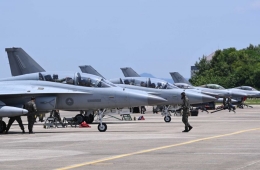
[Asia Economy Yang Nak-gyu, Military Specialist Reporter] It has been revealed that the amount spent on importing American-made weapons has significantly increased under the current administration. There are calls to use this as leverage in the Special Measures Agreement (SMA) negotiations on defense cost-sharing between South Korea and the United States.
According to the Defense Acquisition Program Administration on the 20th, before the Moon Jae-in administration took office in 2016, the total amount of overseas weapons imports was 745 billion KRW, of which 456.7 billion KRW was for American-made weapons, accounting for 61% of the total. Then, in the first year of the administration in 2017, it increased to 1.5216 trillion KRW, with the American-made weapons share slightly rising to 68% (1.0359 trillion KRW). In 2018, out of 3.8878 trillion KRW, 3.2636 trillion KRW was American-made, sharply increasing the share to 84%.
This trend has continued to the present. In 2019, overseas weapons imports slightly decreased to 2.5389 trillion KRW (American-made 2.099 trillion KRW, 82%). In September of that year, President Moon Jae-in announced a three-year weapons procurement plan at the South Korea-US summit, and President Donald Trump responded by saying, "South Korea is a major customer purchasing our military equipment."
Since then, the amount spent on American-made weapons has increased again, with 3.5095 trillion KRW (76% of the total) spent on weapons from the US last year alone. Considering this year’s American-made weapons such as the GPS-guided bombs (2000 lbs class) 4th project, Air Combat Maneuvering Instrumentation system, and F-15K performance upgrades, the amount payable to the US is expected to exceed 4 trillion KRW.
Experts point out that if importing American-made weapons is inevitable, it should be used as a negotiation card to foster domestic defense companies through offset trade or to resolve defense cost-sharing negotiations.
Kim Jong-ha, Dean of the Graduate School of Business and Defense Strategy at Hannam University, said, "The current administration has not leveraged the expansion of American-made weapons purchases as leverage in defense cost-sharing negotiations," adding, "Unilateral weapons purchases do not benefit the national interest."
Hot Picks Today
!["Why Securities Analysts Expect the KOSPI to Hit 9,500 Next Week [Weekend Money]"](https://cwcontent.asiae.co.kr/asiaresize/93/2026062409233021342_1782260609.jpg) "Why Securities Analysts Expect the KOSPI to Hit 9,500 Next Week [Weekend Money]"
"Why Securities Analysts Expect the KOSPI to Hit 9,500 Next Week [Weekend Money]"
- Suspended Sentence for Taxi Driver in His 70s Who Caused Center Line Accident Resulting in Death of 9-Month-Old Japanese Baby
- The Strategy Has Failed... Even If South Korea Miraculously Reaches Round of 32, It Will Face Belgium
- "Losing Jobs and Selling Bean Sprouts: Why They Left a Job Earning 6.76 Million Won per Month"
- Korea on the Brink: Iran Draws with Egypt to Take Advantage in Round of 32 Race over Korea [2026 World Cup]
Kim Yong-su, Chairman of the Defense Small and Medium Venture Business Association, also urged, "We need to create various win-win strategies such as increasing orders for domestic defense companies or receiving technology transfers through offset trade."
© The Asia Business Daily. All rights reserved. Unauthorized AI training and use prohibited.