Sterilizers for Ingredients and Tableware Used as Humidifier Disinfectants for 4 Years in University Hospitals
SACHAMWI, Survey Results on 23 Hospitals and Nursing Homes
Misuse Confirmed at One University Hospital
Calls for Ministry of Health's Full Investigation and Measures
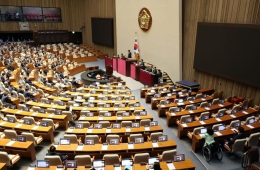
![On the 29th, Choi Ye-yong, Vice Chairman (second from the left), is speaking at a press conference announcing the investigation results related to the 'Use of Humidifier Disinfectants in Hospitals' held by the Special Investigation Committee on the Humidifier Disinfectant Incident and the April 16 Sewol Ferry Disaster in Jung-gu, Seoul. <br>[Image source=Yonhap News]](http://www.asiae.co.kr/news/img_view.htm?img=2020062911501031624_1593399011.jpg)
On the 29th, Choi Ye-yong, Vice Chairman (second from the left), is speaking at a press conference announcing the investigation results related to the 'Use of Humidifier Disinfectants in Hospitals' held by the Special Investigation Committee on the Humidifier Disinfectant Incident and the April 16 Sewol Ferry Disaster in Jung-gu, Seoul.
[Image source=Yonhap News]
[Asia Economy Reporter Jeong Dong-hoon] The Special Investigation Commission on Social Disasters (Sacheomwi) confirmed that from 2007 for over four years, A University Hospital used food ingredients and dish sterilizers as humidifier disinfectants.
From November 2018 to March 2020, Sacheomwi commissioned a 'Humidifier Disinfectant Usage Multi-use Facility Survey' and investigated usage status at 23 hospitals and nursing homes. As a result, it was confirmed that A University Hospital used Haicrojeong, a dish sterilizer, as a humidifier disinfectant.
Choi Ye-yong, Chairperson of the Humidifier Disinfectant Incident Truth Investigation Subcommittee, stated, "It was the first confirmation that the hospital unknowingly misused dish sterilizers as humidifier disinfectants for a long time according to the 'Infection Control Guidelines.' The Ministry of Health and Welfare and others should conduct a full survey of hospitals' infection control guidelines to check if similar cases occurred in the past and prepare related measures," he urged.
A University Hospital used 'Haicromini (product name Haicrojeong),' a dish sterilizer, as a humidifier disinfectant according to the hospital's internal 'Infection Control Guidelines.' This is the first confirmation that a hospital continuously and systematically used humidifier disinfectants based on explicit infection control guidelines. No cases of illness or death related to humidifier disinfectant health damage due to Haicrojeong use at the hospital were confirmed. The main ingredient of Haicrojeong is sodium dichloroisocyanurate (NaDCC). According to animal experiments by the National Institute of Environmental Research, this ingredient has inhalation toxicity. Toxic changes in the lungs were observed in tests related to repeated inhalation exposure.
Haicrojeong is a product that should not be used for humidifier sterilization or disinfection purposes under the Food Sanitation Act. The manufacturer launched Haicrojeong in 2003 as a 'mixed formulation food additive' and changed its category to 'sterilizer and disinfectant for instruments, etc.' in 2009. When classified as a mixed formulation food additive, it should only be used for sterilizing and disinfecting food ingredients; when classified as a sterilizer and disinfectant for instruments, it should only be used for sterilizing and disinfecting food utensils.
Hot Picks Today
 "If You Don't Buy Now, Prices Will Rise Even More": North Korean Gasoline Prices Surpass South Korea as Panic Buying Spreads Amid War Ripple Effects
- "I Can't Say No Even If I Want To"... Pretending to Be Okay in Front of Children, Stress Builds Up in 'Twilight Childcare'
- Surviving on Cup Noodles in a Tiny Studio, Sent 800 Million Won... "Wife Enjoyed Parties and Golf"
- "22 Million Won Deposited Monthly"... The Secret Was Winning Both Online and Offline
- "President Yoon, I Love You"... The Beautiful Woman in Her 20s Who Shouted 'Yoon Again' Was Actually
However, pharmaceutical wholesaler C created and sold product descriptions containing false statements that Haicrojeong was "a product developed for bacteria inside humidifiers and indoor air sterilization and disinfection purposes." C company's advertising and sales activities violated Article 11 (Prohibition of False Labeling, etc.) of the Food Sanitation Act at the time they began selling it as a humidifier disinfectant in 2007, making them subject to administrative sanctions. However, the then Korea Food & Drug Administration (now the Ministry of Food and Drug Safety) and local governments failed to detect this. Company B supplied 37,400 tablets under the name 'Humidifier Haicro' to A University Hospital from February 2007 to June 2011.
© The Asia Business Daily(www.asiae.co.kr). All rights reserved.